
Yoga for Flexibility Singapore: A Masterclass in Mindful Range of Motion
Yoga for Flexibility Singapore: A Masterclass in Mindful Range of Motion
What if the secret to overcoming a persistent “Singapore neck” isn’t found in a deeper stretch, but in a smarter one? Many professionals find themselves trapped in a cycle of lower back tightness and rigid posture, feeling increasingly distant from the fluid movement they see on social media. It’s common to feel intimidated by advanced poses or frustrated by generic routines that yield no real progress. Whether you’re seeking relief from office-induced tension, looking to improve your daily mobility, or simply wanting to feel more graceful in your body, practicing yoga for flexibility Singapore offers a path toward lasting change. We understand that true range of motion is a delicate balance of strength, safety, and surrender.
In this expert-led guide, you’ll discover how to transform stiff muscles into fluid movement through a masterclass in mindful range of motion. We’ll move beyond the surface-level pull of traditional stretching to explore how structural integrity and nervous system safety create sustainable results. You’ll learn to breathe, align, and evolve. This article previews the essential methodologies for building a mindful movement habit that empowers your body and restores your sense of calm confidence.
Key Takeaways
- Understand how the “Singapore Neck” impacts your structural integrity and why slow, sustained holds are essential for releasing the connective tissue web known as fascia.
- Learn to work with your body’s natural stretch reflex rather than fighting it, ensuring your practice of yoga for flexibility Singapore remains safe, mindful, and effective.
- Master the “Active Engagement” technique to protect your joints, refine your posture, and move beyond the common plateau of passive stretching.
- Deconstruct the myth that you must be flexible to start yoga by understanding how your brain uses stiffness as a protective mechanism.
- Discover the synergistic power of Yogalates, where core stability, mindful breathing, and intentional stretching converge for optimal results.
Why Flexibility is Essential for the Modern Singaporean Lifestyle
Flexibility is often misunderstood as the ability to perform impressive contortions for a social media feed. In reality, it’s the fundamental capacity of your joints to move through their full range of motion without pain. For the modern professional, practicing yoga for flexibility Singapore isn’t about vanity; it’s about structural survival. Our bodies were designed for motion, yet the demands of a high-pressure urban environment often dictate otherwise. When we lose this range, we don’t just lose movement; we lose the ability to inhabit our bodies with ease.
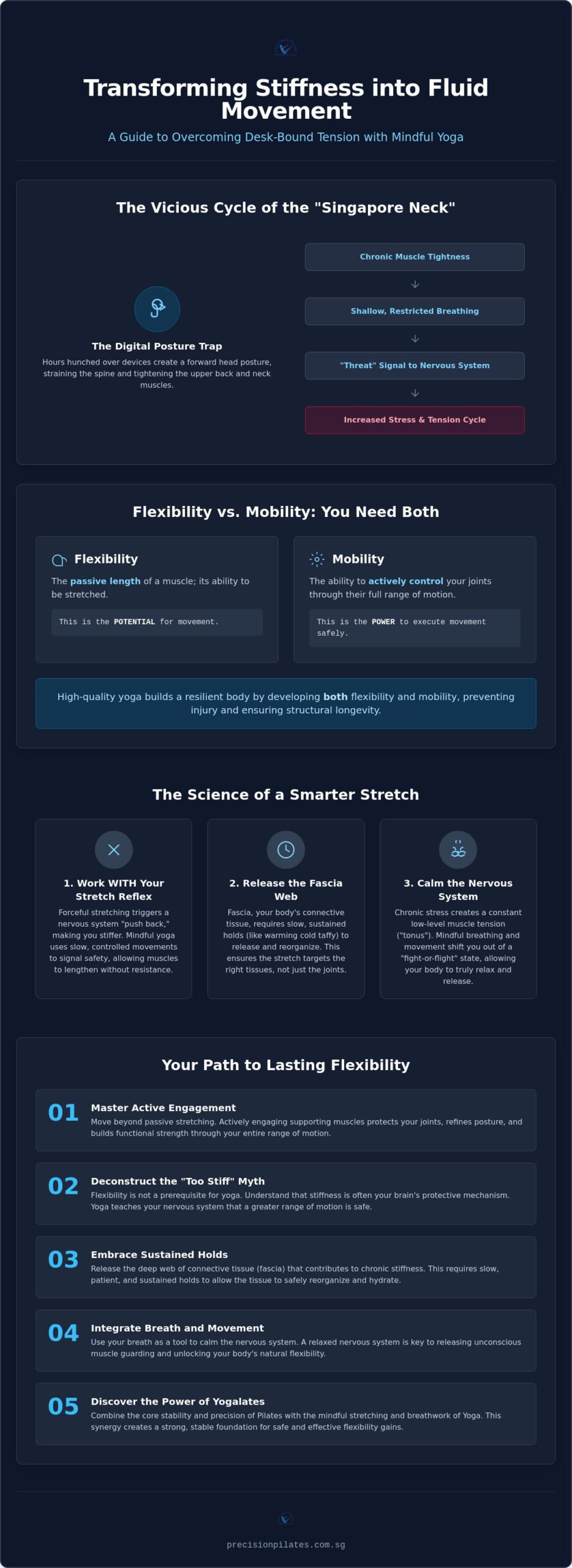
The “Singapore Neck” phenomenon is a prime example of this physical decline. Hours spent hunched over laptops or tilted toward smartphones create a forward head posture that strains the cervical spine and tightens the upper trapezius. This isn’t just a cosmetic issue. When your muscles are chronically tight, they compress the rib cage, leading to shallow, restricted breathing. This physical restriction sends a constant signal of “threat” to the brain, increasing stress levels and creating a cycle of tension that feels impossible to break. Yoga offers the tools to interrupt this cycle through intentional, mindful movement.
The Cost of a Sedentary National Culture
The typical 9-to-5 desk work culture takes a heavy toll on our internal architecture. Long hours of sitting cause the hip flexors to shorten and the thoracic spine to stiffen. Over time, this decreased range of motion contributes to common workplace injuries, from repetitive strain to acute lower back pain. Yoga serves as a necessary architectural reset for the body. By engaging in Yoga as exercise, you provide your system with the counter-movements it craves. It’s an intentional practice of unravelling the knots tied by a day at the office, allowing you to restore, refine, and recover.
Flexibility vs. Mobility: Why You Need Both
While many use these terms interchangeably, they represent different aspects of physical health. Flexibility refers to the passive length of a muscle, while mobility is the ability to control that range of motion through active strength. High-quality yoga classes Singapore emphasize both to ensure structural longevity. Without mobility, a flexible muscle is vulnerable to injury because it lacks the support of its surrounding stabilizers. Flexibility provides the potential for movement, but mobility provides the power to execute it safely. By focusing on yoga for flexibility Singapore, you aren’t just stretching; you’re building a body that is resilient, responsive, and truly free to move.
The Mechanics of Mindful Movement: How Yoga Enhances Flexibility
Understanding the mechanics of yoga for flexibility Singapore requires looking beneath the surface of the skin. Most people believe stretching is a simple mechanical tug of war with a muscle. However, your body possesses a sophisticated safety mechanism called the Stretch Reflex. When you pull a muscle too quickly or too forcefully, your nervous system triggers an involuntary contraction to prevent a tear. It’s a protective “push back” that actually makes you stiffer. To bypass this, we use slow, controlled movements that signal safety to the brain, allowing the muscle to yield and lengthen without resistance.
Beyond the muscle fibers lies the fascia, a complex connective tissue web that encases everything in your body. While muscles can stretch relatively quickly, fascia is more like cold taffy; it requires slow, sustained holds to release and reorganize. According to 9 Benefits of Yoga, this practice improves more than just reach; it enhances total structural balance. By holding poses with intention, you’re hydrating this tissue and breaking down the “fuzz” that accumulates from inactivity. This process ensures the stretch hits the target tissue rather than stressing your joints.
The Nervous System: Your Secret to Flexibility
Chronic stress creates a state of “tonus,” a permanent low-level muscle tension that makes your body feel like a steel cable rather than a wet noodle. When you’re stuck in a fight-or-flight state, your nervous system keeps your muscles braced for impact. Through Pranayama, or mindful breathwork, we signal the parasympathetic nervous system to take over. This shift is the “secret sauce” of yoga for flexibility Singapore. It moves your body from a state of guarded rigidity to one of receptive ease. This process also refines your Proprioception. This is your body’s internal GPS, helping you understand where you are in space so you can move with greater precision.
Yoga Styles Optimized for Range of Motion
Different styles of practice offer unique pathways to opening the body. Whether you’re a beginner or a seasoned practitioner, selecting the right modality is key to your progress. Hatha Yoga provides foundational alignment and steady, purposeful holds to build a strong baseline. Yin Yoga targets the deep fascial layers through long, passive holds that encourage connective tissue health. Vinyasa uses dynamic flow to build internal heat, prepping the muscles for deeper mobility. If you’re ready to experience this neurological shift firsthand, exploring our Yoga Classes Singapore can help you find the perfect entry point for your journey.
How to Start Your Flexibility Journey: A 5-Step Practice Guide
Embarking on a journey of yoga for flexibility Singapore doesn’t require a pre-existing level of athleticism. Many beginners feel hindered by their perceived stiffness, but the practice is designed to meet you exactly where you are. To move from rigid tension to fluid grace, you need a structured methodology that respects your body’s current boundaries while gently expanding them. This five-step guide provides a roadmap for a safe, effective, and mindful practice.
- Step 1: Assess your baseline. Before you begin, take a moment to notice where you feel restricted. Is it the backs of your legs, your chest, or perhaps your outer hips? Document these sensations without judgment or comparison to others.
- Step 2: Prioritize “Active Engagement.” Avoid the temptation to passively “hang” in a pose, which can overstretch ligaments and stress your joints. Instead, engage the muscles surrounding the joint to create a stable foundation for the stretch.
- Step 3: Utilize props. Blocks, straps, and bolsters are your greatest allies. They bring the floor to you, allowing you to maintain structural integrity rather than compromising your alignment to reach a specific point.
- Step 4: Master the “70% Rule.” True progress happens when you stay within a range where your breath remains steady and deep. Never push into sharp pain or breathless states; if you can’t breathe comfortably, you’ve gone too far.
- Step 5: Establish rhythmic consistency. A daily fifteen-minute practice is far more transformative than a sporadic two-hour session. Consistency signals to your nervous system that it’s safe to let go of chronic tension.
As you begin, you’ll find that the rewards extend far beyond the physical. According to the University of Rochester Medical Center in their guide on Why You Should Try Yoga, this practice not only increases range of motion but also reduces the risk of injury by improving the mind-body connection.
The Essential Flexibility Tool Kit
Having the right tools can significantly enhance your experience. A yoga block is indispensable for maintaining a long spine in standing folds, especially if your hamstrings are tight. A yoga strap acts as an extension of your arms, helping you reach your feet in seated poses without rounding your back. Finally, a supportive, high-grip mat provides the necessary cushion for your knees and wrists during floor work, ensuring your focus remains on the movement rather than discomfort.
Creating a Sustainable Home and Studio Routine
While home practice is valuable, starting with professional instruction helps you avoid “baked-in” alignment errors that can lead to long-term strain. In a studio setting, you can explore advanced techniques like Proprioceptive Neuromuscular Facilitation (PNF), which is a stretching protocol involving the strategic contraction and relaxation of muscles to safely deepen your range. Between sessions, try integrating ten-minute “micro-stretches” into your busy Singaporean workday to keep your fascia hydrated and your posture aligned. This balanced approach ensures that yoga for flexibility Singapore becomes a sustainable, lifelong habit.
Addressing the “Too Stiff for Yoga” Myth and Other Plateaus
The most common reason people avoid yoga for flexibility Singapore is the belief they aren’t already flexible. It’s a classic paradox; you don’t do yoga because you’re flexible, you do yoga to become so. Stiffness isn’t usually a permanent physical limit of your muscle fibers. Instead, it’s often a protective mechanism of the brain. If your nervous system perceives a certain range of motion as “unsafe,” it will physically brace your muscles to prevent you from entering that space. Progressing in yoga is as much about convincing your brain that it’s safe to let go as it is about physical tissue change. If this resonates with you, our dedicated guide to yoga for beginners Singapore offers a structured, approachable pathway to building your foundational practice with confidence.
Hydration and nutrition play a silent but vital role in this evolution. Connective tissue requires water and specific nutrients to maintain its elastic quality. Without proper hydration, your fascia becomes brittle and “sticky,” making even the most mindful practice feel like moving through mud. To maintain fluid movement, you must nourish your body from the inside out, ensuring your architectural foundation is as resilient as it is receptive.
The Psychological Barrier to Progress
The “ego stretch” is perhaps the greatest obstacle to lasting flexibility. When we push too hard to mimic an advanced pose, we often trigger the very tension we’re trying to release. This leads to injury, frustration, and set-backs. Patience is your most powerful tool. Flexibility is a journey of months, not days. It’s helpful to reframe “stiffness” as a form of stability that simply needs to be gently mobilized. By respecting your current boundaries, you invite your body to expand them naturally. You must learn to breathe, align, and evolve.
Identifying and Breaking Through Plateaus
It’s normal to see rapid progress in the first few months of yoga for flexibility Singapore, only to hit a frustrating plateau. When this happens, it’s often a sign that your body has adapted to your current routine. To break through, try switching from static holds to dynamic movement patterns that challenge your muscles in new ways. This is also where building supporting strength becomes essential. Incorporating reformer pilates Singapore can be transformative. The resistance of the reformer helps strengthen the muscles that support your new range of motion, giving your brain the confidence to allow deeper stretches.
Don’t underestimate the power of sleep and recovery. Your muscle fibers and fascia undergo repair and reorganization while you rest. Without adequate sleep, your tissues remain inflamed and resistant to lengthening. If you’re ready to move past your perceived limits and experience a truly expert-led approach to movement, book a trial class with us today and begin your journey toward a more graceful, empowered body.
Holistic Integration: Combining Yoga and Pilates for Optimal Results
True physical transformation occurs at the intersection of strength and surrender. While yoga focuses on the mindful expansion of your range, Pilates provides the structural reinforcement necessary to support that new-found space. This synergy is perfectly captured in our Yogalates Classes, a hybrid modality designed to stabilize, lengthen, and refine the body simultaneously. By integrating the two, you ensure that your progress in yoga for flexibility Singapore is built upon a foundation of core stability. This stability acts as a physical “anchor,” allowing your nervous system to feel secure enough to grant deeper access to tight muscle groups without the risk of overextension.
The boutique experience plays a vital role in this journey. In a high-end, expert-led environment, the focus shifts from general instruction to personalized refinement. Small-group attention ensures that every movement is executed with clinical precision, protecting your joints while maximizing the efficacy of every stretch. Viewing flexibility as a pillar of long-term holistic wellness allows you to move beyond temporary relief and toward a sustainable habit of graceful, empowered movement.
Why Precision Matters in Flexibility
There is a significant difference between a “gym stretch” and an expert-led alignment session. A generic stretch often targets the path of least resistance, bypassing the actual areas of tension. In contrast, a specialized session focuses on the subtle nuances of your unique anatomy. Personalized adjustments can often unlock years of “stuck” tension in a single session by realigning the pelvis or shoulders to their optimal positions. Our sanctuary-like environment facilitates the mental release required for this physical change; it’s a space where you can disconnect from urban stress and reconnect with your internal rhythm.
Your Next Steps Toward Fluidity
The journey from a rigid, office-strained posture to a state of fluid mobility is a structured progression. It begins with awareness, moves through science-backed practice, and concludes with holistic integration. Whether you’re a seasoned practitioner or a complete beginner, the most effective way to start is through a tailored approach that respects your individual needs. We invite you to experience this difference firsthand.
By choosing a Trial Class, you can explore our methodology and feel the immediate impact of mindful range of motion. Mindful movement is more than just exercise; it’s a commitment to your future self. It’s a promise of longevity, vitality, and ease. Your path toward a more flexible and resilient body is ready to begin; we’re here to guide you through every intentional breath and every graceful movement.
Embrace Your Path to Fluid Motion
Transforming your physical experience from one of rigid restriction to fluid grace is a journey of patience, precision, and practice. You now understand that overcoming the “Singapore neck” or lower back tightness requires more than just pulling on muscles; it’s about signaling safety to your nervous system and respecting your body’s internal architecture. By combining the mindful expansion of yoga with the structural reinforcement of Pilates, you create a resilient foundation for long-term health. Whether you seek to resolve chronic desk-bound tension or simply wish to inhabit your body with more grace, our tailored approach meets you exactly where you are.
At our Marine Parade sanctuary, expert-led instruction and small-group classes ensure your journey is safe, effective, and deeply restorative. We utilize premium equipment and a holistic methodology to help you unlock the transformative power of yoga for flexibility Singapore. You deserve to move with ease, strength, and renewed confidence. Begin your journey to fluidity with a trial class at Precision Pilates Studio. Your body is ready to evolve, and we’re here to guide you through every intentional breath and mindful movement.
Frequently Asked Questions
Is yoga better than traditional stretching for flexibility?
Yoga is generally more effective than traditional stretching because it addresses the body as a whole. It combines physical lengthening with nervous system regulation and mindful awareness. While traditional stretching focuses on the muscle fiber alone, yoga uses the breath to signal safety to the brain. This holistic approach ensures that your progress in yoga for flexibility Singapore is sustainable, safe, and deeply integrated into your daily life.
How long does it take to see results from yoga for flexibility in Singapore?
You’ll likely feel a sense of immediate relief after your first session, but structural changes take time. Most practitioners notice a significant improvement in their daily mobility within four to six weeks of regular practice. Consistency is the key to remodeling connective tissue. By committing to a steady rhythm, you allow your body to gradually adapt, refine, and transform its internal architecture over the coming months.
Can I do yoga if I can’t even touch my toes?
Touching your toes is a result of the practice, not a requirement to begin. Many people start their journey with yoga for flexibility Singapore specifically because they feel stiff or restricted. We use props like blocks and straps to bring the floor to you. This ensures you can experience the benefits of every pose regardless of your current range. It’s about personal growth, not perfect poses.
How many times a week should I practice yoga to improve my range of motion?
For most individuals, practicing two to three times a week provides the ideal balance of stimulus and recovery. This frequency allows your nervous system to habituate to new ranges of motion while giving your tissues time to repair. Some practitioners prefer shorter, daily micro-sessions to maintain fluidity. The most important factor is finding a sustainable rhythm that fits your lifestyle and keeps you motivated and focused.
Is it better to stretch in the morning or the evening?
The best time to practice depends on your personal goals and daily schedule. A morning session helps hydrate the fascia and wake up the body after hours of stillness. An evening practice is excellent for unravelling the knots of a stressful workday and preparing the mind for restorative sleep. Listen to your body’s needs. Choose the time that feels most supportive for your overall physical and mental wellbeing.
What should I wear to my first yoga class to ensure I can move freely?
Choose comfortable, form-fitting athletic wear that moves with your body. High-waisted leggings and a supportive top are excellent choices; they stay in place during various transitions and inversions. Avoid clothing with excessive zippers or heavy seams that might dig into your skin during floor work. Being able to move, breathe, and stretch without distraction is essential for a focused and productive first session in the studio.
Are there specific yoga poses I should avoid if I have very tight hamstrings?
You don’t need to avoid any poses entirely, but you should modify them to protect your structural integrity. In deep forward folds, keep a slight bend in your knees and use blocks to support your hands. This prevents you from overcompensating with your lower back. By prioritizing alignment over depth, you ensure the stretch stays in the muscle belly rather than pulling on the delicate tendons around your joints.
Can yoga help with flexibility even if I am an older adult?
Yoga is a powerful tool for maintaining vitality and range of motion at any age. It helps preserve joint health, improves balance, and enhances the mind-body connection. For older adults, the practice focuses on gentle mobilization and functional strength. This proactive approach helps you stay active, independent, and graceful. It proves that it’s never too late to begin a mindful movement habit that supports your longevity. For those seeking the combined benefits of core stability and mindful stretching, exploring yogalates Singapore offers an ideal fusion practice that adapts beautifully to every stage of life.

Article by
Precision Pilates Studio Singapore
Precision Pilates Studio Singapore is a boutique Pilates and wellness studio in Marine Parade offering Reformer Pilates, Mat Pilates, Yoga, Yogalates, Sound Healing, Breathwork and personalised movement sessions. Our content is created to provide practical, educational information that supports safer movement, better posture, strength, mobility and overall wellbeing.
Disclaimer
The information in this article is provided for general educational and informational purposes only. It is not intended to replace professional medical advice, diagnosis or treatment. Individual needs and health conditions vary. Please consult a qualified healthcare professional before beginning a new exercise or wellness programme, especially if you are pregnant, recovering from an injury, experiencing pain or managing a medical condition. Precision Pilates Studio does not provide medical diagnosis or treatment.