
Pilates for Mobility Singapore: A Guide to Moving with Freedom and Ease
Pilates for Mobility Singapore: A Guide to Moving with Freedom and Ease
What if the feeling of being locked in your own body isn’t an inevitable side effect of your career, but a signal that your joints are craving a more sophisticated kind of attention? It is common to feel resigned to the persistent stiffness that follows long office hours, the restriction in your hips, or the subtle fear of injury during high-intensity training. If you are seeking pilates for mobility Singapore, you are likely looking for a way to move through your day with more fluidity and far less restriction.
We agree that true physical freedom requires a movement practice that prioritizes balance, harmony, and structural integrity. This guide promises to show you how a dedicated Pilates practice enhances joint health, expands your range of motion, and transforms your daily functional movement for a more vibrant life. We will explore the practicalities of our methodology, moving from the mechanics of the spine to the release of deep-seated tension, providing a clear path to a sustainable and expert-led movement practice that leaves you feeling informed and inspired.
Key Takeaways
- Master the distinction between passive flexibility and active joint control to lay the foundation for lifelong physical vitality.
- Explore how the mechanics of lengthening under tension and spinal articulation create the structural integrity needed for fluid, graceful movement.
- Uncover how a dedicated practice of pilates for mobility Singapore serves as a powerful antidote to the physical toll of sedentary desk hours and urban stress.
- Discern the unique advantages of Reformer and Mat Pilates to tailor a movement practice that aligns perfectly with your individual needs and aspirations.
- Connect physical mechanics with mental tranquility by understanding how mindful breathwork acts as an internal massage for your diaphragm and ribs.
Understanding Mobility: The Foundation of Life-Long Vitality
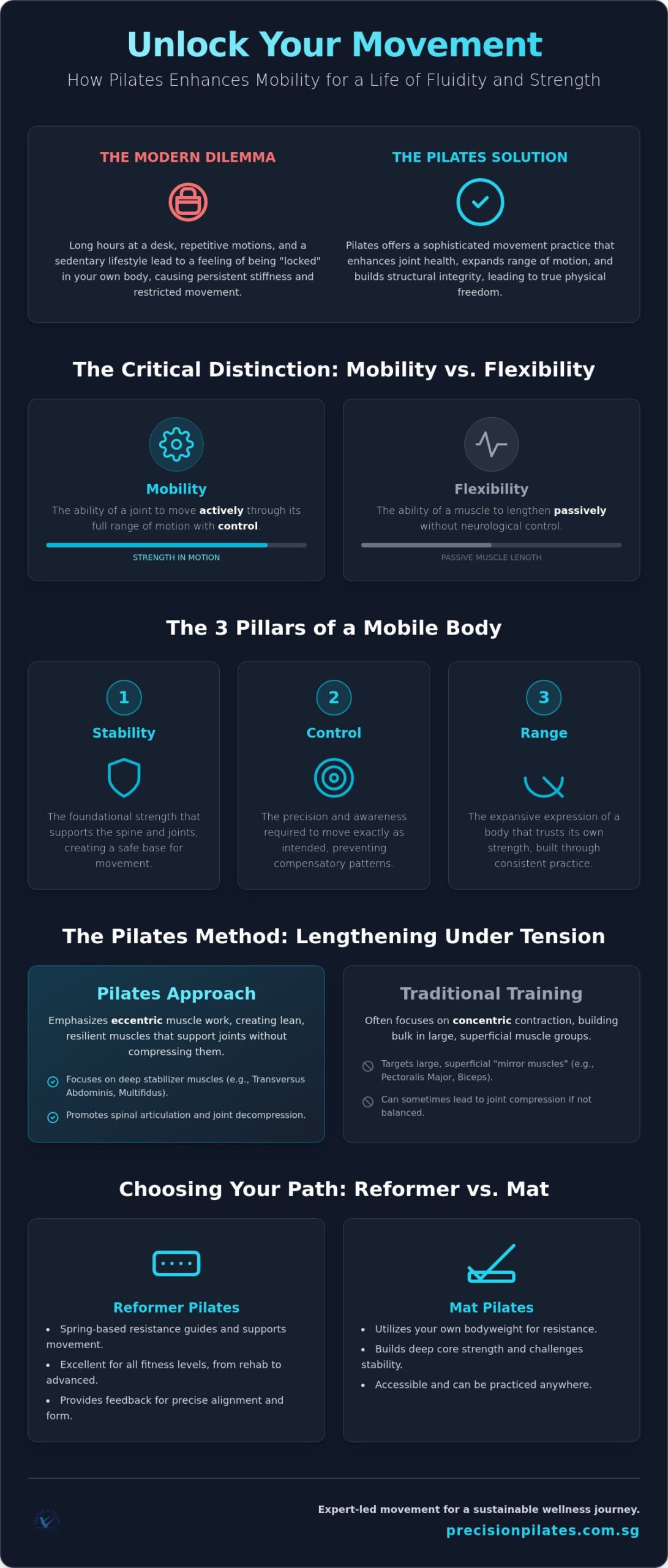
Mobility is the sophisticated capacity of a joint to move actively through a full range of motion. It is far more than simple flexibility. While flexibility describes the passive length of a muscle, mobility represents your nervous system’s ability to control and stabilize that length during movement. This distinction is the cornerstone of a dedicated practice of pilates for mobility Singapore. When you possess true mobility, you move with intention, grace, and structural integrity. It serves as the silent architect of a pain-free life, ensuring your body remains resilient against the physical demands of a modern lifestyle.
In our studio, we view movement through the lens of “strength in motion.” This principle suggests that power is useless without the ability to direct it safely through space. To appreciate the depth of this methodology, one might ask, What is Pilates? At its core, it is a system designed to harmonize the body and mind, fostering a physical state where every joint functions at its peak potential. This holistic approach ensures that your progress isn’t just about physical exertion, but about internal refinement and lasting change.
Why Mobility Declines and How to Reclaim It
The human body is remarkably efficient. If you don’t regularly access your full range of motion, your nervous system begins to “lock” joints as a protective measure. Over time, repetitive patterns like sitting at a desk or carrying a heavy bag cause the body to lose its natural fluidity. This decline isn’t just a result of aging; it’s a result of disuse. Reclaiming this lost territory requires a gentle, expert-led intervention, which is why pilates for mobility Singapore has become a preferred choice for those seeking a sustainable wellness journey. Whether you are recovering from a sedentary period or looking to enhance your athletic performance, pilates for beginners Singapore offers a structured pathway to re-educate your body and restore its innate freedom.
The Three Pillars: Stability, Control, and Range
To build a mobile body, we focus on three essential elements that work in concert. These pillars ensure that your movement is not only expansive but also sustainable and safe.
- Stability: This is the quiet, foundational strength that supports the spine and joints. Without stability, the body will refuse to move into new ranges to protect itself from injury.
- Control: Movement without precision often leads to compensatory patterns. We emphasize the focus and awareness required to move exactly as intended, ensuring every muscle does its fair share.
- Range: This is the ultimate expression of a body that trusts its own strength. It is the result of consistent, mindful practice that expands your physical boundaries.
By integrating these pillars, we create a movement practice that is both clinical in its precision and serene in its execution. This balanced approach allows you to unlock your potential in a focused environment, leading you from a state of stiffness to a state of motivated readiness.
The Mechanics of Movement: How Pilates Enhances Joint Health
Pilates operates on a unique biomechanical principle often described as lengthening under tension. Unlike traditional weightlifting that focuses primarily on concentric contraction, Pilates emphasizes eccentric muscle work. This approach creates a lean, resilient muscular structure that supports the joints without compressing them. By prioritizing this refined method of training, pilates for mobility Singapore provides a path to physical longevity that feels both therapeutic and empowering. It’s about building a body that is as strong as it is supple, ensuring that every movement is supported by deep structural integrity.
Many conventional gym routines target the large, superficial muscles, often neglecting the deep stabilizers that reside closer to the bone. Pilates intentionally recruits these smaller muscle groups, such as the multifidus and transversus abdominis, which are essential for maintaining posture and joint alignment. There is significant scientific evidence for Pilates suggesting that this focus on deep core engagement directly correlates with improved peripheral limb mobility. When the trunk is stable and the core is active, the nervous system allows the shoulders and hips to move with greater freedom and less restriction.
Spinal Mobility: The Central Axis of Health
A rigid core is often a brittle one. In our practice, we move away from the idea of a “stiff” midsection toward a supple, articulated spine. Exercises that promote decompression and functional rotation help to counteract the gravitational pressure of daily life. Spinal articulation is the segmented movement of the vertebrae to distribute load evenly. By moving the spine bone-by-bone, we encourage hydration of the intervertebral discs and release tension that often feels “locked” in the back. This rhythmic, controlled movement restores the spine’s role as the central axis of fluidity and ease.
Hip and Shoulder Functionality
The hips and shoulders are the most mobile joint complexes in the body, yet they are frequently the most restricted due to sedentary habits. Pilates addresses these areas by creating “space” within the joint capsule through controlled, eccentric movements. This refinement of movement patterns leads to a noticeable improvement in gait and overall posture. Whether you are walking through the city or reaching for a high shelf, the benefits of improved hip and shoulder mobility translate into everyday ease. If you are ready to experience this transformation, consider beginning your journey with a trial class at our boutique sanctuary.
Overcoming the Stiffness Trap: Pilates for the Modern Singaporean Lifestyle
Singapore’s urban rhythm is relentless. Long commutes, extended desk hours, and the constant hum of digital demands create a physical environment that quietly works against the body’s natural desire to move. The result isn’t simply tiredness; it’s a progressive accumulation of tension that settles into the tissues, narrows the breath, and dims the body’s innate vitality. This is the stiffness trap, and it’s far more nuanced than generic fitness advice tends to acknowledge.
One of its most insidious expressions is what movement specialists refer to as “tech neck” and “desk slouch.” When the head migrates forward to meet a screen, the cervical spine absorbs a disproportionate load, compressing the structures that support natural breathing mechanics. The chest closes. The diaphragm loses its full excursion. Shallow, clavicular breathing becomes the default, which in turn activates the body’s stress response. Movement becomes labored, posture collapses further, and the cycle perpetuates itself. Addressing this pattern is precisely where a dedicated practice of pilates for mobility Singapore proves its value beyond the studio walls.
For women navigating the particular demands of professional life, caregiving, and personal ambition, the physical toll is often compounded by chronic postural compromise. A thoughtful practice of pilates for women Singapore offers a proactive framework for reclaiming postural grace, not as a vanity pursuit, but as a foundational act of self-stewardship that supports every other demand on the body.
Counteracting the ‘Desk Body’
Three areas bear the heaviest burden of sedentary work: the hip flexors, which shorten and tighten from prolonged sitting; the chest, which collapses inward as the shoulders round; and the upper back, which becomes chronically fatigued from holding a forward-head position. Mindful movement interrupts this cycle of chronic muscular holding. Simple Pilates-inspired interventions, such as seated spinal rotation, standing hip flexor lengthening, or a gentle thoracic extension over a chair back, can be woven into the workday to restore circulation and reset postural tone. These aren’t just stretches; they’re neuromuscular re-education in miniature.
Low-Impact Movement for High-Stress Lives
High-intensity training has its place, but it demands recovery that many busy Singaporeans simply can’t prioritize. The controlled, rhythmic sequencing of Pilates offers something different: a movement practice that actively calms the nervous system while simultaneously building functional strength. This parasympathetic engagement is not a byproduct; it’s a design feature. By building a sustainable movement habit rooted in precision rather than exertion, you create a practice that genuinely supports your life rather than adding another source of depletion to it.
Choosing Your Path: Reformer vs. Mat Pilates for Optimal Mobility
Not all movement tools serve the same purpose, and understanding the distinction between Reformer and Mat Pilates is one of the most clarifying decisions you can make for your mobility journey. Both modalities share the same foundational philosophy, yet each offers a genuinely different quality of physical experience. Choosing wisely between them, or combining them thoughtfully, depends on where your body currently is and where you intend to take it.
The Reformer Advantage: Assisted Range of Motion
The Reformer’s genius lies in its spring-based resistance system. The moving carriage, combined with adjustable springs and long loops, provides continuous proprioceptive feedback that guides the body into precise alignment during every exercise. This tactile information is something a floor or a wall simply cannot replicate. When you feel the carriage respond to your movement, you develop a far more sophisticated understanding of where your body is in space.
For mobility work specifically, the spring resistance facilitates joint decoaptation, gently creating space within the joint capsule during movement to reduce compression and allow the surrounding tissues to lengthen more freely than they could under full body weight alone. This makes the Reformer particularly valuable for those exploring hip rotation, shoulder girdle work, or spinal extension where gravity would otherwise restrict range. At our studio, sessions are conducted on premium Allegro 2 Reformers, which offer the calibrated precision necessary for this kind of refined, responsive work. To explore what reformer pilates Singapore can offer your mobility practice, the detail is in the equipment as much as the methodology.
Mat Pilates: Mastering Your Own Resistance
Mat work demands something the Reformer cannot fully replicate: the ability to organize and mobilize your body using nothing but internal effort. There are no springs to assist a hip hinge or stabilize a rotation. This self-reliance builds a different quality of strength, one rooted in coordination, endurance, and the seamless flow between transitions. The skills developed through mat pilates Singapore translate with remarkable directness into everyday functional movement, from rising off the floor gracefully to carrying groceries without postural collapse.
Mat practice is also inherently portable. The principles you internalize in the studio become accessible anywhere, making it a sustainable mobility habit for a demanding urban life.
A practical framework for choosing between them: if your mobility is currently limited by restriction, tension, or post-sedentary stiffness, the Reformer’s assisted range offers a safer and more supported entry point. If your foundation is established and your goal is functional integration, mat work refines and consolidates those gains. Many practitioners find that alternating between both modalities within their practice of pilates for mobility Singapore yields the most complete results. Speak with our instructors to design a session structure that genuinely matches your body’s current needs.
Beyond the Physical: Integrating Mindful Movement for Holistic Wellbeing
A body that cannot settle cannot fully open. This is perhaps the most overlooked truth in mobility training. When the nervous system is running in a state of low-grade vigilance, a condition that Singapore’s pace of life sustains almost effortlessly, the tissues hold. Muscles brace. Joints compress. No amount of stretching will override a nervous system that has decided the body is not safe enough to release. True mobility, then, is not simply a physical achievement. It is a state of integrated calm that begins in the mind and expresses itself through the body.
This is where a dedicated practice of pilates for mobility Singapore reveals its deepest value. The controlled environment of a boutique studio, the precision of expert instruction, and the deliberate use of breath and stillness create conditions in which the nervous system can genuinely downregulate. Movement becomes medicine not through force, but through trust.
The Power of Breath in Fluid Movement
Lateral thoracic breathing, the foundational breath pattern of Pilates, does something remarkable. As the ribcage expands three-dimensionally with each inhale, the intercostal muscles lengthen, the thoracic spine decompresses, and the diaphragm descends with its full natural range. This is breathwork functioning as an internal massage, mobilizing the very structures that desk posture and chronic stress progressively stiffen. A deep, complete exhale also signals safety to the nervous system, which is the precise condition required for the body to surrender into a deeper stretch without protective guarding. For those who wish to complement their Pilates practice with a varied approach to flexibility and breath awareness, exploring yoga classes Singapore offers a thoughtfully curated counterpart that deepens this mind-body integration.
Recovery as a Mobility Strategy
Restoration is not passive. It’s strategic. Sound healing and meditation, both offered within our studio’s wellness framework, work at a physiological level to reduce the muscular holding patterns that accumulate beneath conscious awareness. The resonant frequencies of sound healing have been observed to support a shift into parasympathetic dominance, the state in which tissue repair, fascial release, and genuine recovery become possible. Sometimes, moving more freely requires doing less, but doing it with complete intention.
Visiting a holistic wellness studio Singapore that integrates these modalities means your recovery is as expertly designed as your movement sessions. At our studio, you can build a personalized wellness journey that weaves Reformer and Mat Pilates with Breathwork, Meditation, and Sound Healing into a coherent whole. Mobility, practiced this way, becomes a pathway to longevity, mental clarity, and a quality of daily life that is genuinely, sustainably vibrant.
Your Next Step Toward Fluid, Unrestricted Movement
Physical freedom isn’t a destination you arrive at suddenly. It’s built steadily, through consistent practice, expert guidance, and a movement environment designed to support genuine transformation. This guide has traced that path from the foundational distinction between flexibility and true mobility, through the biomechanics of joint health, the realities of Singapore’s sedentary demands, and the complementary strengths of Reformer and Mat work, arriving finally at the deeper truth that lasting mobility requires a calm, integrated nervous system as much as a strong body.
What sets a dedicated practice of pilates for mobility Singapore apart is the quality of attention behind it. At Precision Pilates, expert-led sessions on premium Allegro 2 Reformers within a boutique wellness sanctuary mean you’re never working in isolation. Every session is shaped around your body’s specific needs, your current restrictions, and your longer-term aspirations.
You don’t need to move perfectly to begin. You simply need to begin. Begin your journey to fluid movement with a trial class at Precision Pilates Studio and discover what your body is genuinely capable of.
Frequently Asked Questions About Pilates for Mobility
Is Pilates better than yoga for improving mobility?
Neither is universally superior; they serve different but complementary purposes. Pilates builds the deep neuromuscular control and joint stability that allows your range of motion to expand safely and sustainably. Yoga tends to emphasize passive lengthening and breath-led stillness. For those whose mobility is limited by muscular weakness or postural collapse rather than pure tissue tightness, Pilates often produces more durable structural results.
Many practitioners find that combining both modalities yields the most complete outcome. Our studio offers yoga classes alongside Reformer and Mat Pilates precisely because these practices reinforce each other beautifully, addressing both the active control and the receptive release that genuine mobility requires.
How often should I practice Pilates to see improvements in my mobility?
Two to three sessions per week is a practical starting point for most people seeking meaningful mobility gains. At this frequency, the nervous system begins to consolidate new movement patterns between sessions rather than simply recovering from them. Consistency matters far more than intensity; a shorter, focused session twice weekly will outperform an occasional intense class.
Results vary depending on your starting point and how much sedentary time your lifestyle involves. Those with significant postural restriction from desk work may notice initial changes in ease and range within three to four weeks of regular practice.
Can I do Pilates if I am already very stiff or inflexible?
Yes, and in fact significant stiffness is one of the strongest reasons to begin. Pilates is designed to meet your body exactly where it is. The spring-assisted resistance of the Reformer is particularly well-suited to those with restricted range, as it supports the body through movement rather than demanding full range immediately. No prior flexibility is required to start.
Expert instruction is the key variable here. In a boutique studio environment with small-group or private sessions, your instructor can modify every exercise to suit your current capacity, ensuring that your practice is both safe and genuinely progressive from your very first class.
What is the difference between flexibility and mobility in Pilates?
Flexibility is the passive length a muscle can achieve when an external force, like gravity or a partner’s assistance, is applied. Mobility is your nervous system’s ability to actively control movement through that range. You might be flexible enough to touch your toes when seated but lack the hip mobility to hinge cleanly during a standing exercise. Pilates targets mobility specifically.
This distinction shapes every aspect of a dedicated practice of pilates for mobility Singapore. Rather than simply stretching tissues, the work trains your body to own its range, creating movement that is stable, intentional, and genuinely functional in daily life.
Is Reformer Pilates or Mat Pilates better for lower back mobility?
For lower back mobility specifically, the Reformer offers a distinct early advantage. The spring resistance allows the spine to decompress and articulate through supported ranges that body weight alone would make difficult or uncomfortable. Exercises performed on the carriage can gently traction the lumbar spine while the surrounding musculature learns to release its protective holding patterns.
Once a foundational level of spinal control is established, mat work becomes an excellent complement, challenging the lower back to stabilize and mobilize using purely internal effort. Many practitioners benefit from beginning with Reformer sessions and gradually integrating mat work as their spinal awareness and strength develop.
Can Pilates help with joint pain caused by a sedentary lifestyle?
It can, though it’s important to distinguish between movement-related discomfort from disuse and clinical conditions requiring medical assessment. Sedentary habits cause joints to stiffen through reduced synovial fluid circulation and muscular deconditioning. Pilates addresses both by encouraging controlled, full-range movement that lubricates joints and rebuilds the deep stabilizing muscles that protect them.
If you’re experiencing persistent joint pain, we’d always recommend consulting a healthcare professional before beginning any new movement practice. Once cleared, a thoughtfully sequenced Pilates program, particularly in a small-group or private setting, can be a genuinely effective strategy for rebuilding joint comfort and functional ease.
Do I need any special equipment to start Pilates for mobility at home?
A quality non-slip mat is the only essential item for mat-based Pilates practice at home. Small props like a resistance band, a foam roller, or a Pilates ring can add variety and challenge, but they’re not prerequisites for meaningful work. The foundational exercises that build spinal articulation, hip control, and shoulder stability require nothing beyond your own body and a clear floor space.
Home practice works best as a complement to studio sessions rather than a replacement. The calibrated feedback of a Reformer and the precision of expert instruction are difficult to replicate independently, particularly in the early stages of building body awareness and movement literacy.
How long does it take to feel more mobile after starting Pilates classes?
Many people report a noticeable shift in ease and postural awareness after just four to six sessions, particularly in areas like the thoracic spine and hips that respond quickly to targeted, mindful movement. This initial change reflects nervous system adaptation rather than structural tissue change, which takes longer to consolidate.
Deeper, lasting improvements in joint range and functional movement typically become apparent after six to twelve weeks of consistent practice. The timeline is individual and depends on factors including session frequency, lifestyle habits, and starting mobility levels. What most practitioners share is a sense of moving with less effort and greater confidence well before they reach measurable range-of-motion milestones.

Article by
Precision Pilates Studio Singapore
Precision Pilates Studio Singapore is a boutique Pilates and wellness studio in Marine Parade offering Reformer Pilates, Mat Pilates, Yoga, Yogalates, Sound Healing, Breathwork and personalised movement sessions. Our content is created to provide practical, educational information that supports safer movement, better posture, strength, mobility and overall wellbeing.
Disclaimer
The information in this article is provided for general educational and informational purposes only. It is not intended to replace professional medical advice, diagnosis or treatment. Individual needs and health conditions vary. Please consult a qualified healthcare professional before beginning a new exercise or wellness programme, especially if you are pregnant, recovering from an injury, experiencing pain or managing a medical condition. Precision Pilates Studio does not provide medical diagnosis or treatment.