
Pilates for Runners Singapore: Enhancing Performance and Preventing Injury
Pilates for Runners Singapore: Enhancing Performance and Preventing Injury
The secret to a faster personal best on the humid trails of MacRitchie Reservoir isn’t necessarily more mileage; it’s the structural precision found on a Pilates reformer. Many dedicated athletes find themselves struggling with recurring knee pain, stiff hips, or a stride that feels increasingly heavy as the kilometres add up. You understand that running requires grit and endurance, but the repetitive impact can often lead to subtle imbalances that hinder your progress. Precision, stability, and symmetry are the foundational elements that prevent these small issues from becoming chronic injuries.
Athletes preparing for the Standard Chartered Singapore Marathon or those who enjoy a quiet sunrise loop at East Coast Park find that pilates for runners Singapore provides the core power and mental resilience needed to maintain form. This methodology focuses on alignment, breath, and control to build a body that moves with efficiency rather than effort. We will explore how these specialised movements improve running economy, support faster recovery times, and ensure your posture does not collapse during the final kilometres of a race.
Key Takeaways
- Understand how targeting deep muscle stabilisers helps break the cycle of repetitive impact and supports the management of common running injuries.
- Discover how improving pelvic stability and foot alignment can help address recurring knee discomfort and inefficient stride patterns.
- Learn why resistance-based training on the Reformer is particularly effective for joint decompression and building eccentric muscle strength.
- Explore how specific breathwork techniques can support better oxygen management and mental stamina during the challenging final stages of a race.
- See how incorporating pilates for runners Singapore into your routine builds the foundational core power required to maintain efficient form on local trails.
Why Running Miles Isn’t Enough: The Case for Pilates for Runners in Singapore
Running along the Marina Bay waterfront or through the lush paths of the Rail Corridor requires more than cardiovascular endurance. While many athletes in our city state focus on increasing their weekly mileage, true performance gains often come from what happens off the pavement. For those seeking pilates for runners Singapore, the practice is defined as a system of functional movement that specifically targets the deep stabilising muscles that traditional running often overlooks. These small but vital muscles provide the structural integrity required to withstand the physical demands of long distance training.
The concept of running economy is central to this approach. It refers to how efficiently an athlete uses oxygen at a specific pace. When your core is unstable, your body wastes energy through unnecessary lateral movements or a collapsing stride. By cultivating a stable centre, you reduce this wasted effort, allowing every ounce of energy to propel you forward. This is why the growing interest in pilates for runners Singapore reflects a shift toward more sustainable athletic practices among the local community at Precision Pilates Studio Singapore.
The Impact of Repetitive Motion
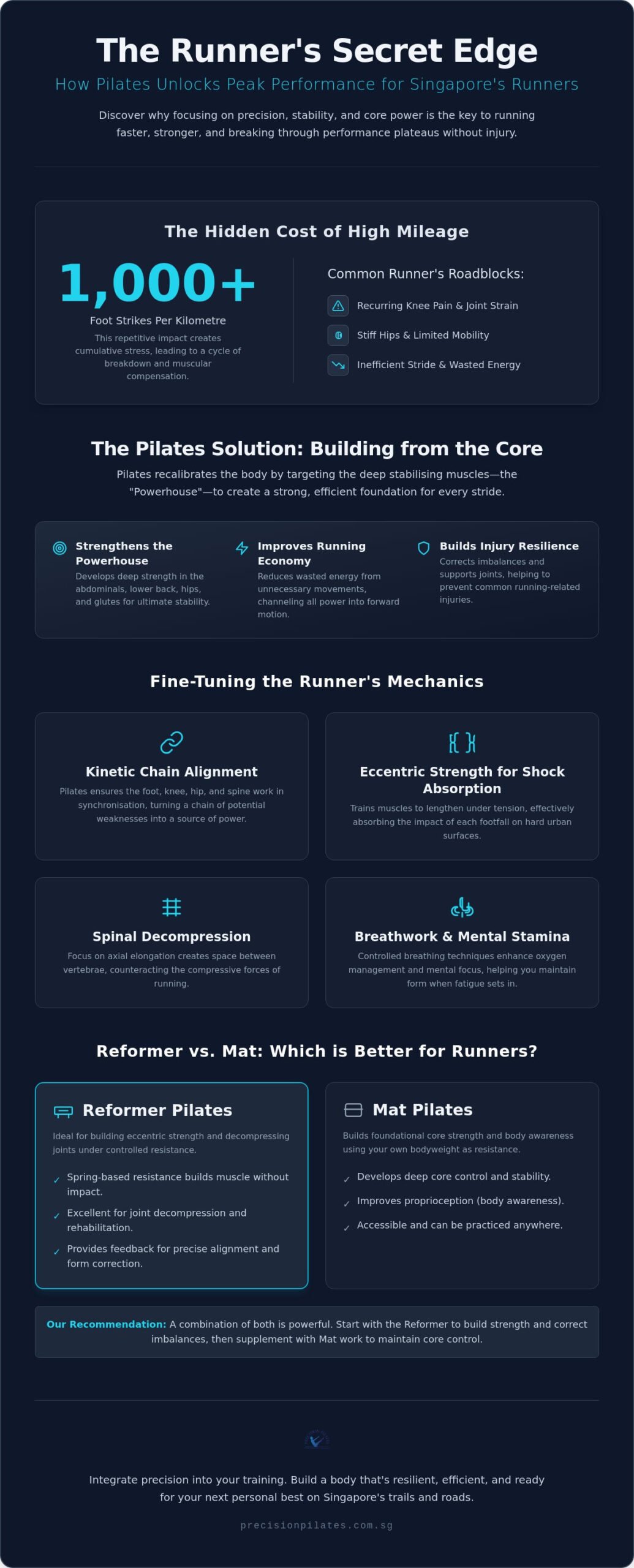
Every kilometre involves approximately 1,000 foot strikes, creating a cumulative wave of stress that travels up the kinetic chain. Over time, this repetitive motion can lead to a breakdown cycle where the body begins to compensate for fatigue. A common pattern involves overactive quadriceps and sleepy gluteal muscles, a combination that often leads to knee strain and lower back discomfort. Pilates serves as a physical recalibration, realigning the skeletal structure and rebalancing muscle tension to ensure every joint moves as intended.
Building Resilient Foundations
In the studio, the Powerhouse refers to the collective strength of the abdominals, lower back, hips, and glutes. Unlike general gym work that may focus on superficial muscle groups, this method emphasises the precision of deep abdominal engagement. It encourages a transition from repetitive movement to a state of intentional movement, where every step is supported by an internal scaffolding. This internal strength ensures that even during the most humid afternoon runs, your form remains crisp and your joints remain protected.
Core, Hips, and Feet: The Mechanics of Running Efficiency
Running is a complex sequence of movements where the foot, knee, hip, and spine must work in perfect synchronisation. This sequence, known as the kinetic chain, means that an imbalance in the foot can manifest as a sharp pain in the hip or a dull ache in the lower back. For those practicing pilates for runners Singapore, the focus shifts to how these individual parts communicate. Peer-reviewed research shows Pilates improves running economy by refining these mechanics, allowing you to move with greater ease and less fatigue.
One of the most critical aspects of this efficiency is eccentric loading. During a run, your muscles must act as shock absorbers, lengthening under tension to control the impact of each landing. Pilates excels at training this specific type of strength, particularly through controlled movements on the reformer. This preparation helps the body manage the jarring forces of running on the hard concrete pavements found across Singapore’s urban landscape. It’s about building a body that can absorb force without breaking down.
Regular practice also facilitates spinal decompression. The repetitive impact of running can compress the intervertebral discs over time. By focusing on axial elongation and core support, you create space between the vertebrae, counteracting gravity and the constant pounding of the road. If you’re curious about how these mechanics apply to your own stride, you might consider booking a session to experience the difference first-hand. This targeted approach ensures your training remains productive and sustainable.
Pelvic Control and Hip Mobility
Many runners in Singapore spend their workdays seated at desks, which often leads to chronically tight hip flexors. These tight muscles can inhibit the glutes, preventing them from firing correctly during a run. Pilates addresses this through exercises like the Side Leg Series, which build the lateral stability needed to prevent a “hip drop.” Maintaining a neutral pelvis ensures that the lower back remains protected and the glutes can provide the necessary power for every step. This stability is the key to preventing common ITB issues.
Foot and Ankle Alignment
A powerful push-off begins with the feet. Proper foot articulation and ankle stability are essential for navigating the uneven trails of Bukit Timah or the winding paths of the Botanic Gardens. Working on the Pilates apparatus improves proprioception, which is your body’s ability to sense its position in space. The foot-to-core connection starts on the reformer’s footbar, teaching the body to maintain alignment from the very moment of impact. Stable feet lead to stable knees, creating a more resilient athlete.
Reformer vs. Mat Pilates: Which is Better for Your Running Goals?
Choosing between the Reformer and the Mat is rarely an either-or decision for a serious athlete. For those seeking pilates for runners Singapore, the distinction lies in the type of feedback your body receives. The Reformer provides resistance, support, and immediate sensory feedback. The Mat, conversely, demands total self-regulation and intrinsic control. Integrating both into your routine ensures you develop the structural strength of a machine and the intuitive awareness of a seasoned runner.
A balanced weekly schedule might include one Reformer session to address deep mechanical imbalances and one Mat session to reinforce body awareness. This dual approach helps you build the resilience needed for the humidity and hard surfaces of our city. It’s about creating a body that is both strong and adaptable. When your core is trained to respond to different challenges, your running form remains consistent regardless of the terrain.
The Power of the Allegro 2 Reformer
The Allegro 2 Reformer is a sophisticated tool that uses spring resistance to mimic the varying loads and impacts of a run. Unlike static weights, these springs provide a fluid tension that requires the muscle to control the movement in both directions. This is particularly effective for eccentric muscle lengthening, where the muscle strengthens as it extends; a vital component for absorbing shock. Exercises like “Footwork” on the Reformer serve as a prerequisite for a healthy running gait, teaching the feet, ankles, and knees to track correctly under load. This controlled, smooth movement builds the long, lean muscle required for endurance without adding unnecessary bulk.
Mat Pilates for Proprioceptive Mastery
While the Reformer provides a helpful guide, Mat work forces you to find stability without any external assistance. This develops a deep sense of proprioception, which is your body’s ability to sense its position in space. This skill is invaluable when you’re navigating the technical trails of the Green Corridor or the winding paths of Bedok Reservoir. Because these exercises require nothing more than a small space, they are incredibly portable for pre-race warm-ups or post-run cool-downs. Developing a consistent Mat Pilates Singapore practice ensures your core remains a reliable anchor even when you’re far from the studio. It teaches you to align, strengthen, and restore your body using only your own internal resistance.
Beyond Physical Strength: Breathwork and Mental Stamina for Long-Distance
Performance on the road is often dictated by the internal state as much as muscular output. While physical conditioning is vital, the ability to manage the nervous system during the final stages of a race is what separates a strong finish from a struggle. For those exploring pilates for runners Singapore, the practice offers a sophisticated method for refining respiratory efficiency and mental resilience. This internal focus helps athletes navigate the “pain cave” during the Standard Chartered Singapore Marathon or long weekend training sessions with a sense of composed control.
The mental stamina required for long distance running is built through the discipline of mindful movement. Every repetition in a Pilates session requires absolute concentration on alignment, engagement, and timing. This level of focus trains the brain to remain present and calm under physical stress. When you are twenty kilometres into a run in the tropical heat, this mental clarity allows you to maintain efficient form even as fatigue begins to set in. It’s about creating a psychological anchor that prevents the panic of exhaustion from taking over.
Respiratory Efficiency on the Run
Lateral thoracic breathing is a core principle of the Pilates method that offers significant advantages for runners. Unlike shallow chest breathing, this technique encourages the ribcage to expand sideways and backwards, allowing for maximum oxygen intake without sacrificing core stability. Maintaining a firm centre while breathing deeply ensures that your internal scaffolding remains intact, protecting the spine during high impact movement. Ribcage mobility is essential; a stiff mid back often leads to restricted breathing and early fatigue. Intentional breath serves as a rhythmic anchor during long runs, synchronising your stride with your internal tempo for a more efficient oxygen exchange.
The Recovery Revolution
True competitive advantage lies in the speed and quality of your recovery. In a city where professional stress can be high, the body often remains in a sympathetic “fight or flight” state, which hinders muscle repair. Integrating Sound Healing Singapore and Breathwork sessions into your routine can help shift the body into a parasympathetic state, accelerating the healing process. This restorative mindset balances the high intensity of marathon training, ensuring you return to the pavement feeling refreshed rather than depleted. Balancing performance with stillness is a hallmark of a mature athlete who values longevity as much as speed.
If you are ready to refine your internal performance and recovery, you can book a trial class to experience our specialised approach to athletic wellness. This integrated strategy ensures your body and mind are equally prepared for the challenges of the road.
Elevate Your Run with Precision Pilates Studio
Precision Pilates Studio Singapore provides a refined space where technical expertise meets a supportive, expert-led environment. Our boutique studio prioritises quality over quantity, ensuring that every session is conducted in small groups for personalised attention. We utilise premium Allegro 2 Reformers, which offer the smooth resistance and versatility required to challenge an athlete’s body without overstressing the joints. This focus on individualised care allows our instructors to observe your movement patterns closely, identifying the subtle compensations that often lead to fatigue on the road.
The instructors at our studio possess a deep understanding of the specific biomechanical needs of the Singaporean running community. We recognise that the repetitive nature of training for events like the Sundown Marathon requires a specialised approach to cross-training. By integrating pilates for runners Singapore into your weekly routine, you gain access to a methodology that emphasises structural integrity and functional power. Our team acts as a sophisticated mentor, guiding you through controlled movements that translate directly into a more efficient and resilient running stride.
Tailored Private and Semi-Private Sessions
A one-on-one assessment is often the most effective way to pinpoint the unique postural imbalances that may be hindering your performance. During these sessions, we focus on your specific gait, hip mobility, and core engagement to create a targeted plan for improvement. For those who prefer to train with a partner or running teammate, our semi-private sessions offer a collaborative yet focused experience. This level of Private Pilates Singapore ensures that your training is precisely aligned with your personal goals, whether you are rehabilitating an injury or seeking a new personal best. These sessions provide the clarity and direction needed to refine your physical mechanics with absolute confidence.
Your Sanctuary for Performance and Wellness
Our studio is designed to be a serene retreat from the city hustle, offering a focused atmosphere where you can concentrate entirely on your physical and mental well-being. We provide a complete suite of cross-training options, including Yogalates and Yoga, to support a well-rounded athletic profile. These practices complement the strength and stability of Pilates by adding elements of flexibility and restorative flow. This combination ensures that your body remains adaptable and your mind remains calm, even during the most demanding training cycles. We invite you to book your trial class at Precision Pilates and discover how a commitment to precision can redefine your running potential.
Refine Your Stride and Sustain Your Performance
Integrating the precision of Pilates into your training schedule offers a strategic advantage that mileage alone can’t provide. By addressing the kinetic chain from the feet to the spine, you build the structural integrity needed to withstand the impact of Singapore’s urban trails. We’ve explored how breathwork supports lung capacity and how eccentric loading on the Reformer helps the body manage shock. These elements work in harmony to ensure your form remains stable even as you approach the final kilometres of your race.
Our boutique studio provides the perfect environment for this change. With premium Allegro 2 Reformers and small-group classes, we offer the personalised attention every athlete requires. Our expert instructors specialise in mindful movement, helping you translate studio strength into road efficiency. Our approach prioritises balance, harmony, and structural integrity. For those seeking pilates for runners Singapore, this method provides the foundation for a more efficient stride.
Start building a stronger, more resilient run with a Trial Class at Precision Pilates.
Investing in your alignment today can help ensure many years of injury-free running and steady progress on the road.
Frequently Asked Questions
Is Pilates better than weight lifting for runners?
Pilates and weight lifting serve different but complementary roles in an athlete’s training programme. While weight lifting is excellent for building absolute power, pilates for runners Singapore focuses on the structural integrity and deep stabilising muscles that support the joints during impact. It emphasises alignment and functional movement, ensuring that the power you build in the gym is used efficiently on the road without causing compensation patterns.
How many times a week should a runner do Pilates to see results?
Most runners experience significant benefits by incorporating one to two sessions per week into their schedule. This frequency is sufficient to build the core power and pelvic stability required for endurance without overtaxing the central nervous system. Consistent practice allows your body to internalise these movement patterns, making them second nature during your long weekend runs at East Coast Park or MacRitchie Reservoir.
Can Pilates help with IT Band Syndrome or Runner’s Knee?
Pilates can support the management of IT Band Syndrome and Runner’s Knee by addressing the underlying biomechanical imbalances. These conditions are often caused by weak gluteal muscles or pelvic instability, which leads to poor tracking of the knee. By strengthening the lateral stabilisers and refining hip mobility, the practice helps reduce the repetitive strain on these sensitive areas, promoting a more balanced and pain-free stride.
Should I do Pilates on my running days or rest days?
Many athletes find that doing Pilates on active recovery days or after a light run works best for their training cycle. Because the method focuses on spinal decompression and eccentric lengthening, it can help realign the body after the jarring impact of a road run. It’s an excellent way to restore the body’s balance without adding the high intensity stress associated with traditional strength training or speed work.
I am very inflexible; can I still do Pilates for runners?
Absolutely, as Pilates is designed to improve functional range of motion rather than achieve extreme flexibility. Many runners have tight hamstrings and hip flexors due to the repetitive nature of their sport. The practice uses controlled stretching and strengthening to create a more resilient body. You don’t need to be flexible to start; instead, you use the method to build the mobility required for a more efficient gait.
What is the difference between Reformer Pilates and a regular gym workout for a runner?
The primary difference lies in the use of spring resistance and the focus on eccentric control. Unlike traditional gym machines that often isolate muscles, the Reformer requires the entire body to work as a cohesive unit. This resistance mimics the varying loads of a run while providing support for joint decompression. It focuses on lengthening the muscles under tension, which is vital for absorbing the shock of every foot strike on concrete.
How does Pilates help with marathon training in Singapore’s climate?
Training in Singapore’s high humidity places immense stress on the respiratory system and mental focus. pilates for runners Singapore teaches lateral thoracic breathing, which maximises oxygen intake while maintaining a stable core. This technique, combined with the mental discipline required for precise movement, helps you manage the psychological challenges of a marathon. It ensures your form does not collapse when the heat and fatigue begin to peak.
Will Pilates make my legs feel too tired for my long runs?
Pilates is specifically designed to be low impact and should leave you feeling aligned rather than exhausted. While you will feel your muscles working, the focus is on quality of movement and structural balance. When integrated correctly into a marathon programme, it acts as a restorative practice that supports your long runs. It builds the endurance of your stabilising muscles, ensuring they can support your primary movers for the duration of your training.

Article by
Precision Pilates Studio Singapore
Precision Pilates Studio Singapore is a boutique Pilates and wellness studio in Marine Parade offering Reformer Pilates, Mat Pilates, Yoga, Yogalates, Sound Healing, Breathwork and personalised movement sessions. Our content is created to provide practical, educational information that supports safer movement, better posture, strength, mobility and overall wellbeing.
Disclaimer
The information in this article is provided for general educational and informational purposes only. It is not intended to replace professional medical advice, diagnosis or treatment. Individual needs and health conditions vary. Please consult a qualified healthcare professional before beginning a new exercise or wellness programme, especially if you are pregnant, recovering from an injury, experiencing pain or managing a medical condition. Precision Pilates Studio does not provide medical diagnosis or treatment.