
Reformer Pilates for Back Pain Relief: Your 2026 Essential Recovery Checklist
Reformer Pilates for Back Pain Relief: Your 2026 Essential Recovery Checklist
What if the solution to your persistent lower back stiffness isn’t found in more rest, but in the controlled, clinical precision of a machine? You’ve likely felt that heavy ache after a long day at the office, wondering if reformer pilates for back pain relief is truly the safe, effective answer you’ve been seeking. It’s common to feel caught between the need to move and the fear of making things worse. Whether you’re recovering from a specific strain or simply seeking to undo years of poor posture, you deserve a path to recovery that feels both expert-led and deeply restorative.
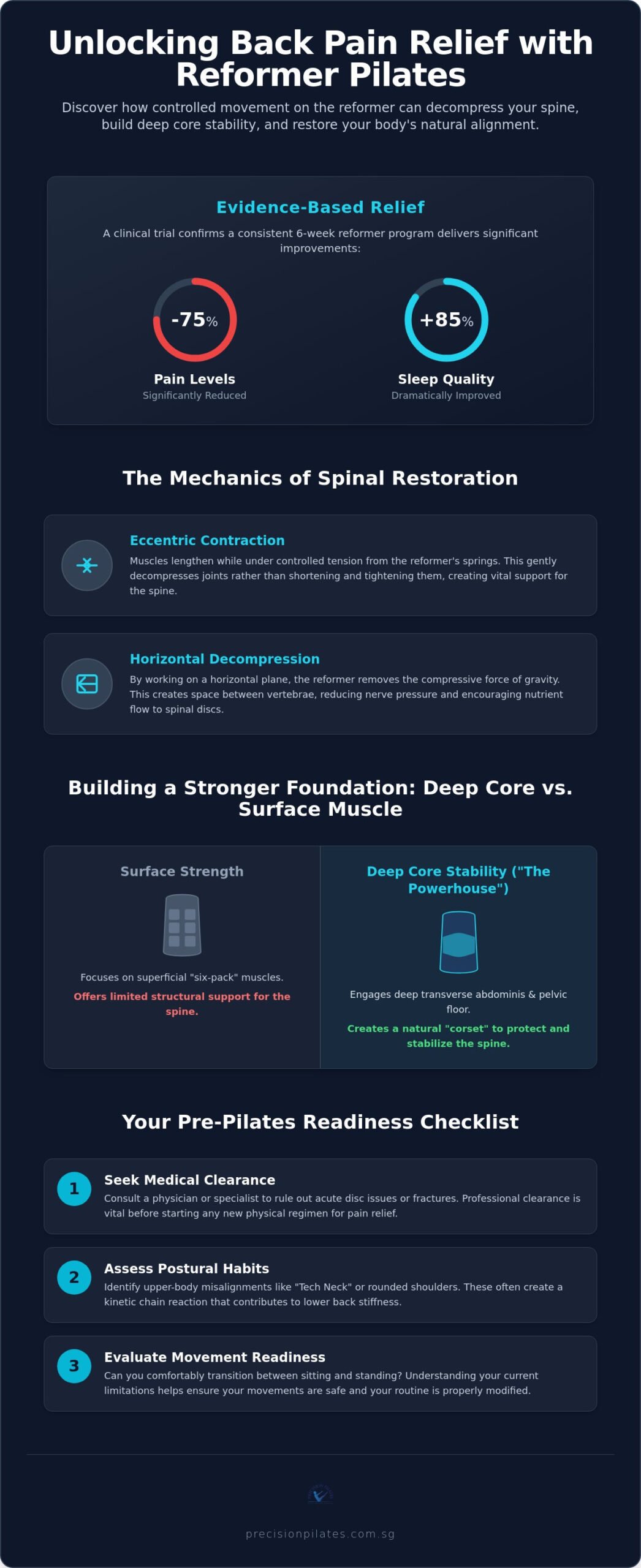
Discover how the targeted mechanics of the reformer provide a structural sanctuary for your spine. Research from a 2025 randomized controlled trial confirms that a consistent six-week reformer program significantly improves pain levels and sleep quality. This essential 2026 checklist will help you understand the specific advantages of equipment like the Allegro 2 Reformer, distinguish between mat and machine work, and build a routine that allows you to align, strengthen, and restore. We’re here to guide you through the transition from daily discomfort to a life of composed, confident movement.
Key Takeaways
- Understand how eccentric contractions decompress joints and lengthen muscles to provide vital structural support for your spine.
- Learn why the precision engineering of the Allegro 2 Reformer allows for a tailored recovery experience that respects your unique physical boundaries.
- Use our pre-pilates readiness checklist to identify specific pain triggers and ensure you’re moving with the proper professional clearance.
- Discover how reformer pilates for back pain relief utilizes the foundation of a neutral spine to build lasting core stability and structural harmony.
- See how the serene sanctuary at Precision Pilates Studio provides the focused instructor attention necessary to correct misalignments before they cause strain.
Understanding the Mechanics: How Reformer Pilates Targets Back Pain
Reformer Pilates is a sophisticated system of movement that utilizes spring-based resistance to prioritize spinal health. Unlike traditional mat exercises, the reformer uses a sliding carriage and a system of springs to provide a controlled environment for recovery. When you seek reformer pilates for back pain relief, you’re engaging with a method that emphasizes precision, control, and alignment. Whether you are recovering from a chronic injury, managing daily stiffness, or seeking to improve your athletic performance, the reformer meets those specific needs with clinical precision. This approach, rooted in the Pilates method, allows the body to move through a full range of motion without the typical stressors of gravity.
The brilliance of the reformer lies in its ability to facilitate eccentric contraction. This occurs when a muscle lengthens while under tension, effectively decompressing the joints rather than shortening or tightening them. By moving the carriage against the resistance of the springs, you are teaching your muscles to support your skeleton in a lengthened state. The horizontal orientation of the machine is equally vital. Because you are often lying down, the compressive force of gravity is removed from your spine, allowing the vertebrae to move freely and safely.
The Role of Spinal Decompression
Daily life often squashes the intervertebral discs through poor posture or high-impact activities. The reformer acts as a mechanical mentor, creating necessary space between the vertebrae. This gentle traction reduces pressure on sensitive nerves and encourages nutrient flow to the spinal discs. The spring system also provides constant sensory feedback to the nervous system. This feedback loop helps your brain recognize proper alignment, making every movement intentional, safe, and restorative.
Core Stability vs. Surface Strength
True relief comes from the “Powerhouse,” the deep internal muscles that act as a natural corset for the lumbar spine. Many people focus on surface-level “six-pack” muscles, but these don’t offer the structural support needed for a healthy back. Reformer pilates for back pain relief targets the deep transverse abdominis and pelvic floor to create a stable foundation. This focus on deep stability ensures that your spine is protected during daily tasks like lifting, reaching, or sitting. By practicing mindful movement, you transition from mere physical exertion to a state of lasting structural integrity.
Evaluating Your Relief Path: A Pre-Pilates Readiness Checklist
Success in recovery begins with a moment of honest self-reflection. Before you begin reformer pilates for back pain relief, you must understand the unique landscape of your discomfort. Does your pain flare after hours of seated desk work, or does it manifest as a sharp pinch when you stand for long periods? Identifying these triggers is the first step toward a tailored recovery. Whether you’re dealing with a recent strain or a decades-old ache, a thoughtful assessment ensures your journey is safe, effective, and sustainable.
Before stepping into the studio, consider this essential readiness checklist to ensure your body is prepared for movement:
- Medical Clearance: Have you consulted a physician or specialist to rule out acute disc issues or fractures? Professional clearance is vital before starting any new physical regimen.
- Postural Awareness: Are you struggling with “Tech Neck” or rounded shoulders? These upper-body misalignments create a kinetic chain reaction that pulls on the lumbar spine, often acting as the hidden culprit behind lower back stiffness.
- Movement Readiness: Can you comfortably transition between sitting and standing, or do you require specific modifications to move safely?
While group classes offer a sense of community, a professional assessment is non-negotiable for those managing pain. A mentor-led evaluation allows an instructor to see the subtle compensations your body makes to avoid discomfort. This precision ensures you don’t reinforce harmful patterns while trying to heal. Exploring the benefits of reformer Pilates through a guided lens helps you unlock your physical potential without the risk of aggravating an existing injury.
Identifying Postural Imbalances
A frequent driver of back pain is the anterior pelvic tilt, where the pelvis tips forward and creates an excessive arch in the lower back. You can perform a simple self-check by standing against a flat wall; if there’s a significant gap between your lower back and the surface, your hip flexors may be pulling your spine out of alignment. Uneven hip height is another common issue that leads to localized pain on one side. Addressing these imbalances through postural imbalance correction pilates is the key to restoring harmony to your musculoskeletal system.
Setting Realistic Recovery Goals
Patience is a foundational virtue of the Pilates philosophy. You may feel immediate relief from the decompression provided by the reformer, but long-term structural change requires time and dedication. Aim for a mindset that prioritizes progress, refinement, and internal change. Consistency is the primary driver of success. By committing to a regular routine, you transform your practice from a mere workout into a reliable sanctuary for your spine. If you’re ready to begin this journey with expert guidance, consider booking a trial class to experience how personalized attention can accelerate your healing process.
The Reformer Advantage: Why Equipment Quality Matters for Back Care
The choice of equipment is a fundamental pillar of your recovery journey. For those seeking reformer pilates for back pain relief, the machine isn’t just a tool; it’s a sophisticated partner in structural alignment. We utilize the Allegro 2 Reformer, a pinnacle of boutique engineering designed for clinical precision. Its adjustable footbars and intuitive spring tensions allow for a truly tailored experience that respects your body’s unique boundaries. Whether you’re managing acute discomfort or chronic stiffness, the quality of the carriage ensures a smooth, silent glide that minimizes jarring impacts on the spine. This high-end approach provides the safety, stability, and support necessary for meaningful progress.
While mat pilates Singapore offers incredible benefits for core precision, the reformer provides a distinct advantage for specific injury support. The machine acts as a supportive frame, guiding the body through movements that might be too taxing or risky on a floor mat. This is particularly crucial for those with limited mobility who require a professional-grade carriage to safely enter and exit exercises. The reformer bridges the gap between physical mechanics and mental tranquility, allowing you to focus on healing without the fear of improper form.
Progressive Resistance and Joint Safety
The spring system on a premium reformer is designed for joint longevity and safety. Unlike free weights that offer a constant or erratic load, springs provide progressive resistance. This means the tension is lightest at the beginning of a movement, when your joints are most vulnerable, and gradually increases as you reach full extension. It creates a “closed chain” environment where your feet or hands remain in contact with a stable surface, providing far more security than open-air movements. A 2025 randomized controlled trial on Pilates for pain highlighted how this controlled approach leads to significant improvements in functional ability and pain reduction. To protect the cervical spine, the reformer’s adjustable headrest and shoulder blocks ensure your neck stays in a neutral, strain-free position. Align, strengthen, and restore with total confidence.
Proprioception and Neuromuscular Re-education
Proprioception is your body’s innate ability to sense its position and movement in space. When you’re in pain, this internal “GPS” often becomes skewed, leading to harmful compensations. The reformer “teaches” your back to move correctly through constant tactile feedback from the straps, springs, and carriage. This neuromuscular re-education is vital for lasting reformer pilates for back pain relief. It doesn’t just strengthen muscles; it rewires how your brain coordinates movement. As you refine these patterns, you carry that sense of harmony into your daily life, preventing future pain episodes and building a body that feels like a resilient sanctuary.
Your 10-Point Checklist for Reformer Pilates Back Pain Relief
Transitioning from understanding the mechanics to practical application requires a structured, intentional approach. To achieve lasting reformer pilates for back pain relief, you must follow a progression that respects the spine’s natural curvature while building the strength needed to protect it. This checklist serves as your roadmap, moving from foundational stability to fluid, controlled mobilization. Whether you’re a beginner or returning after a flare-up, these steps ensure your practice remains a safe sanctuary for recovery.
- Step 1: Master the Neutral Spine. This is the bedrock of the Pilates philosophy. You must learn to maintain the natural curves of your neck, mid-back, and lower back without flattening your spine against the carriage. It is the position where your spine is most resilient and least vulnerable to strain.
- Step 2: Focus on Pelvic Tilts. Use the reformer’s subtle resistance to perform small, controlled tilts of the pelvis. This movement gently mobilizes the lower lumbar vertebrae, increases blood flow to the discs, and wakes up the deep core without the jarring impact of traditional abdominal crunches.
- Step 3: Incorporate “Feet in Straps.” This is often the most transformative part of a session. By placing your feet in the loops, the reformer supports the weight of your legs, allowing for gentle hamstring lengthening and hip mobility. It decompresses the lower back by creating space in the hip sockets.
- Step 4: Practice the “Cat-Cow” on the Reformer. Performing this classic stretch while kneeling on the carriage adds a layer of instability that forces the deep stabilizers to engage. It encourages healthy spinal articulation, helping you move through each vertebra with clinical precision.
If you’re ready to see how these movements feel on professional-grade equipment, you can book a trial class to begin your personalized journey toward a pain-free life.
Essential Movements for Lumbar Support
Beyond the basics, we focus on exercises that build cross-lateral stability. The “Bird-Dog” variation on the moving carriage is a powerful tool; it challenges your balance while forcing the “Powerhouse” to stabilize the lumbar spine. We also prioritize the “Mermaid” stretch, which targets the lateral spine and releases the Quadratus Lumborum (QL), a muscle often responsible for chronic side-back pain. Throughout these movements, your breath acts as an internal brace. Proper diaphragmatic breathing stabilizes the ribcage, ensuring your core remains engaged and your spine remains protected during every repetition.
Mindful Alignment Habits Beyond the Studio
Recovery doesn’t end when you leave the reformer. To sustain your progress, you must bring the Pilates mindset into your daily Singaporean professional life. Use this checklist to audit your daily habits:
- Core Engagement: Are you consciously engaging your deep abdominals when lifting heavy groceries or picking up a child?
- Workstation Setup: Is your monitor at eye level and your chair supporting a neutral spine to prevent “Tech Neck”?
- Frequent Movement: Are you taking short breaks to perform a seated pelvic tilt or a gentle stretch during long office hours?
By integrating these habits, you transform your workspace into an extension of the studio, ensuring your back remains strong, balanced, and resilient.
Finding Your Sanctuary: Precision Pilates Studio for Sustainable Spinal Health
Your recovery journey deserves more than just a clinical setting. It requires a space that balances professional expertise with the warmth of a wellness sanctuary. At Precision Pilates Studio, we view reformer pilates for back pain relief as more than a series of exercises; it’s a transformative experience designed for long-term spinal health. By stepping away from the frantic pace of daily life and into a composed, intentional environment, you give your body the permission it needs to heal. We position ourselves as your “Wellness Architect,” guiding you through a methodical progression toward a pain-free life.
In a boutique environment, we prioritize quality over quantity. Small-group classes ensure that our instructors can monitor every movement, identifying subtle misalignments before they lead to strain. For those requiring a more focused approach, private pilates Singapore offers a highly tailored rehabilitation path. This one-on-one attention allows your mentor to adjust every spring and strap to your specific needs, fostering a sense of calm confidence as you rebuild your strength. Whether you’re managing a specific injury or seeking to correct years of poor posture, this personalized attention is the key to sustainable progress.
Small-Group Attention and Expert Guidance
Precision is the hallmark of effective recovery. Our instructors provide personalized cues that go beyond simple instructions, helping you refine your form and avoid the common pitfalls of unsupervised exercise. By utilizing premium Allegro 2 Reformers in a dedicated, tranquil space, we offer a high-end experience that is both expert-led and emotionally accessible. This steady, composed guidance inspires trust, allowing you to unlock your physical potential in a focused environment. Our mentors understand the musculoskeletal nuances of back pain, ensuring that every session helps you align, strengthen, and restore with total safety.
Integrating Holistic Wellness into Recovery
True recovery addresses the whole person, not just the physical symptoms. We recognize the powerful synergy between yoga classes Singapore and Pilates to enhance overall flexibility and structural harmony. To manage the mental stress that often accompanies chronic pain, we integrate Sound Healing and Breathwork into our holistic offerings. These tools provide a mental sanctuary, helping you navigate the emotional landscape of recovery. This integrated approach ensures a journey of personal growth, moving you from a state of inquiry to a state of motivated readiness.
Moving from a state of persistent pain to one of empowered strength is a profound transformation. Your path to reformer pilates for back pain relief is a partnership, and we’re committed to being your steady, professional guide. By combining clinical precision with a serene atmosphere, we help you build a reliable wellness routine that feels like a sanctuary for your spine and your spirit. It’s time to reclaim your movement and discover the lasting relief that comes from a balanced, resilient body.
Step Into a Life of Fluidity and Strength
Reclaiming your physical potential requires a commitment to precision, patience, and professional guidance. You now understand how the mechanical advantage of the Allegro 2 Reformer decompresses the spine while building the deep stability your body craves. By prioritizing structural alignment over mere exertion, you’ve discovered that reformer pilates for back pain relief is a sophisticated path toward lasting recovery. Whether you’re addressing acute stiffness or refining your daily posture, the journey is about more than just movement; it’s about building a resilient foundation for years to come.
Our boutique studio offers the small-group intimacy necessary for personalized care, ensuring every cue is tailored to your unique musculoskeletal needs. Within this expert-led sanctuary, you can focus on the intentional habits that transform your quality of life. It’s time to move beyond the limitations of pain and toward a state of composed confidence. Begin your journey to a pain-free life with a Trial Class at Precision Pilates. We’re here to help you align, refine, and restore your body with the care it deserves.
Frequently Asked Questions
Is Reformer Pilates safe for a herniated disc?
Reformer Pilates is generally safe and often highly recommended for individuals with a herniated disc. It prioritizes spinal decompression and neutral alignment, allowing you to strengthen your core without the compressive forces found in traditional weightlifting. You must obtain medical clearance from your specialist before starting. Our instructors use that clinical feedback to provide specific modifications, ensuring you avoid harmful flexion or rotation while building a supportive muscular corset.
How many sessions of Reformer Pilates do I need to see back pain relief?
Most individuals begin to experience a reduction in stiffness and improved mobility within four to six consistent sessions. While the immediate decompression often provides temporary relief, true structural change requires a long-term commitment. A regular routine of two to three sessions per week allows your body to rewire its movement patterns. This consistency is the primary driver for achieving lasting reformer pilates for back pain relief and building a resilient spine.
Can I do Reformer Pilates if I have acute lower back pain right now?
You should wait until the initial inflammatory phase of acute pain has subsided before starting a session. If your pain is sharp, radiating, or accompanied by numbness, rest and medical consultation are your first priorities. Once the acute flare-up transitions into a duller, chronic ache, the reformer becomes an ideal tool for recovery. We focus on gentle mobilization and breathwork to safely reintroduce movement to the lumbar region without triggering another episode.
What is the difference between Reformer vs Mat Pilates for back health?
The primary difference lies in the level of support and resistance provided by the equipment. Mat Pilates relies on your ability to work against gravity, which can be challenging if your core is already compromised by pain. The reformer uses springs and a moving carriage to support your weight, making it easier to find a neutral spine. This external feedback is crucial for reformer pilates for back pain relief as it guides you through safe ranges of motion.
Do I need prior experience to join a back-pain-focused class?
Prior experience is not required to begin your recovery journey in our boutique studio. We specialize in introducing beginners to the reformer with a focus on safety and precision. Because we maintain small-group intimacy, your instructor can provide the personalized attention needed to master foundational movements like the neutral spine. Whether you’re entirely new to the practice or returning after a hiatus, we meet you at your current level of physical readiness. If you’re looking for a structured introduction to the machine, our reformer pilates beginners Singapore FAQ guide addresses the most common questions new practitioners encounter before their first session.
What should I wear to my first Reformer Pilates session for back relief?
You should wear comfortable, form-fitting athletic clothing that allows for a full range of motion. Avoid baggy clothes; instructors need to see your hip and spinal alignment to provide accurate corrections. Most boutique studios require grip socks for safety and hygiene on the carriage. These specialized socks provide the traction necessary to maintain stability during standing or kneeling exercises, ensuring you feel secure and supported throughout your entire session.

Article by
Precision Pilates Studio Singapore
Precision Pilates Studio Singapore is a boutique Pilates and wellness studio in Marine Parade offering Reformer Pilates, Mat Pilates, Yoga, Yogalates, Sound Healing, Breathwork and personalised movement sessions. Our content is created to provide practical, educational information that supports safer movement, better posture, strength, mobility and overall wellbeing.
Disclaimer
The information in this article is provided for general educational and informational purposes only. It is not intended to replace professional medical advice, diagnosis or treatment. Individual needs and health conditions vary. Please consult a qualified healthcare professional before beginning a new exercise or wellness programme, especially if you are pregnant, recovering from an injury, experiencing pain or managing a medical condition. Precision Pilates Studio does not provide medical diagnosis or treatment.