
Pilates for Joint Health Singapore: A Reference Guide to Mindful Rehabilitation
Pilates for Joint Health Singapore: A Reference Guide to Mindful Rehabilitation
What if the most effective way to heal an injury isn’t simply to wait, but to engage in a more intentional form of movement? For many, the road to recovery is paved with the frustration of slow progress and a persistent fear of re-injury. You want to regain your confidence. You seek to align, strengthen, and restore. Whether you are managing post-rehab stiffness or looking to fortify your body against future strain, specialized pilates for joint health Singapore provides the structural precision needed to move with clarity, purpose, and strength.
We believe that true rehabilitation is about more than just fixing a single joint; it’s about rebuilding your entire foundation through mindful awareness. This guide explores how controlled movement and better structural alignment can accelerate your recovery and restore your long-term mobility. We’ll look at the vital role of core stability in protecting your joints and how a tailored approach creates a sustainable path to health. It’s time to transform your recovery into an opportunity for lasting physical empowerment and grace.
Key Takeaways
- Understand how to transition from clinical physiotherapy to a mindful practice that focuses on long-term mobility, refinement, and functional movement.
- Master the “Powerhouse” concept to build a foundation of core stability that protects your spine and addresses underlying muscular imbalances.
- Compare the unique benefits of Reformer and Mat Pilates to determine which modality best supports your specific journey toward pilates for joint health Singapore.
- Discover targeted strategies for common injuries, including lower back and knee rehabilitation, through precise, controlled alignment exercises.
- Learn how a boutique studio environment provides the personalized attention and sanctuary needed to restore your body with confidence, clarity, and grace.
Table of Contents
- The Fundamentals of Pilates for Injury Recovery
- Core Mechanics: How Pilates Restores Structural Integrity
- Reformer vs. Mat Pilates for Rehabilitation
- Targeted Recovery for Common Injuries
- Starting Your Recovery at Precision Pilates Studio
The Fundamentals of Pilates for Injury Recovery
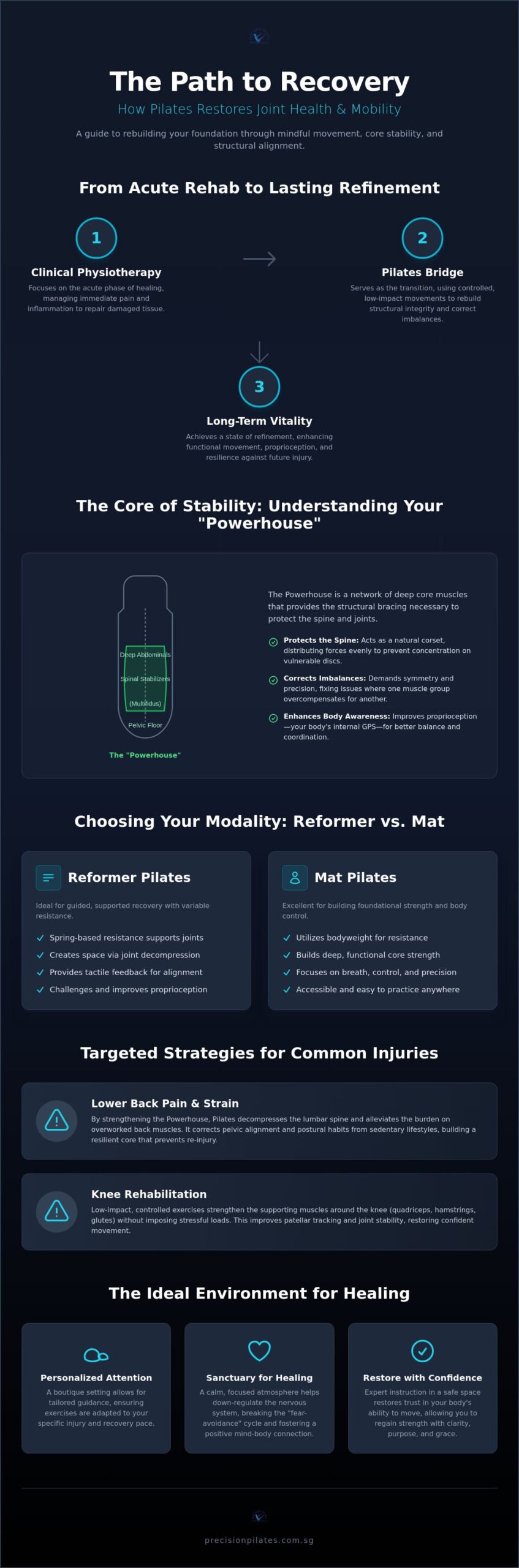
Recovery is a journey that requires patience, precision, and purpose. While clinical physiotherapy often focuses on the acute phase of healing, Pilates for injury recovery serves as the bridge to long-term vitality. It’s a system of controlled, low-impact movements that prioritizes structural integrity over sheer exertion. By focusing on The fundamentals of Pilates, individuals can transition from a state of repair to a state of refinement. In the context of pilates for joint health Singapore, this method offers a sanctuary where movement becomes medicine, allowing the body to heal without the stress of high-impact training.
The Science of Low-Impact Resistance
Spring-based resistance, a hallmark of the Reformer, is a cornerstone of this approach. Unlike weights that rely solely on gravity, springs provide a consistent tension that supports joint decompression. This unique loading helps the body build strength while creating space within the joint capsule. Eccentric muscle contractions play a vital role here, as they lengthen the muscle under tension, which is essential for strengthening connective tissue and improving structural harmony. Eccentric loading is the process of a muscle lengthening while under a load, which significantly improves tendon health and resilience.
Mind-Body Connection in Pain Management
Recovery is often hindered by the “fear-avoidance” cycle, where the anticipation of pain prevents movement. Mindful movement breaks this cycle by encouraging safe, successful experiences with motion. Breathwork acts as a powerful tool to down-regulate the nervous system, shifting the body from a state of stress to a state of healing. By integrating holistic wellness into the physical journey, we address the person as a whole. This comprehensive approach ensures that pilates for joint health Singapore isn’t just about a single joint, but about your complete well-being, confidence, and grace.
Core Mechanics: How Pilates Restores Structural Integrity
At the center of every movement lies the Powerhouse. It’s a sophisticated network of deep abdominal muscles, the pelvic floor, and the multifidus along the spine. This internal support system doesn’t just create a flat stomach; it provides the structural bracing necessary to protect the vertebrae and discs. When we focus on pilates for joint health Singapore, we prioritize this deep stabilization to ensure that the spine remains resilient under pressure. A strong core acts as a corset, distributing forces evenly across the body rather than allowing them to concentrate on vulnerable joints.
Muscular imbalances are often the silent architects of chronic injury. When one muscle group overworks to compensate for a weaker neighbor, the resulting torque can pull joints out of alignment. Pilates addresses these discrepancies by demanding symmetry and precision. By establishing pelvic and scapular stability, we create a steady foundation for the limbs to move freely. This is where reformer pilates Singapore becomes an invaluable tool for recovery. The machine’s springs and pulleys provide immediate tactile feedback, highlighting even the smallest deviations in form and guiding you back toward a neutral, healthy posture.
Correcting Postural Imbalances
Modern life often dictates a seated position, leading to the pervasive issues of “tech neck” and lower back strain. These aren’t just minor discomforts; they’re structural shifts that can lead to long-term degeneration. Using pilates for desk workers Singapore as a recovery strategy allows you to reverse the toll of a sedentary lifestyle. By strengthening the core, you alleviate the burden on peripheral joints like the hips and shoulders. It’s about moving from a state of collapse to a state of expansion, where your body feels light, aligned, and energized.
Proprioception and Balance
Proprioception is your body’s internal GPS, the sense that tells you where your limbs are in space. This awareness is frequently compromised after an injury, leaving you feeling disconnected or unsteady. The unstable surface of a Reformer carriage challenges your deep stabilizing muscles, forcing the brain and body to communicate more effectively. As you refine this body awareness, you develop a natural defense against future trips or strains. If you’re looking to regain this sense of control, you might find that exploring our private sessions offers the focused environment needed to rebuild that vital mind-body link.
Ultimately, restoring structural integrity is a patient process of retraining the nervous system. Through consistent, mindful practice, you don’t just heal the injury; you upgrade your entire movement patterns. This holistic focus on pilates for joint health Singapore ensures that your recovery is both deep and enduring, providing a foundation for a life of pain-free movement and graceful strength.
Reformer vs. Mat Pilates for Rehabilitation
Choosing the right environment for your recovery is just as important as the exercises themselves. Whether you’re navigating the early stages of post-surgical healing or managing a persistent chronic condition, the modality you select dictates the level of support your body receives. In the context of pilates for joint health Singapore, the distinction between Reformer and Mat work is a matter of strategic progression. One provides a supportive framework for fragile joints, while the other challenges the body to find its own internal stability. Understanding this balance is key to a safe and effective return to full mobility.
The Reformer is almost always the starting point for those with limited range of motion or acute pain. It allows for a transition from passive therapy to active movement without the immediate burden of gravity. As you gain confidence and strength, the goal is often to transition toward the Mat. This progression mirrors the natural healing process: moving from assisted, guarded motion to independent, functional power. While extremity injuries like hip or knee strains often require the mechanical assistance of the Reformer, spinal recovery eventually demands the pure, unassisted control found on the Mat.
The Reformer Advantage
For many in recovery, the Reformer acts as a sophisticated partner in movement. We utilize Allegro 2 Reformers to provide a highly adjustable experience where resistance can be fine-tuned to your specific needs. The sliding carriage allows for horizontal movement, which is a game-changer for pilates for joint health Singapore. By removing the vertical compression of your own body weight, you can strengthen the muscles surrounding the knees and hips without irritating the joint surfaces. The pulley system acts as a guide, offering constant tactile feedback that helps you maintain limb alignment and prevents the compensatory shifts that often lead to re-injury.
Mat Pilates for Functional Strength
Mat Pilates is where you truly learn to own your movement. Without the springs of the Reformer to assist or resist, you must rely entirely on your core to support your body weight against the pull of gravity. This modality focuses on pure, deep engagement of the Powerhouse. It’s the ultimate test of your structural integrity. We typically introduce Mat work once a student has established a baseline of alignment and can move through a pain-free range of motion. It’s here that you build the functional strength required for the demands of daily life, ensuring your spine remains protected long after you’ve left the studio.
Ultimately, the journey from the Reformer to the Mat is a journey toward autonomy. It’s a methodical, intentional process that ensures your recovery isn’t just a temporary fix, but a permanent upgrade to your physical foundation. By respecting these stages, you don’t just heal; you thrive.
Targeted Recovery for Common Injuries
Every injury tells a unique story, and every recovery requires a bespoke strategy. While the general principles of core stability provide a foundation, specific pathologies demand a more nuanced, anatomical approach. In our studio, we see a diverse range of conditions, from acute disc herniations to chronic knee instability. Addressing these through pilates for joint health Singapore involves more than just generic movement; it requires a deep understanding of biomechanics to ensure that every exercise serves the goal of long-term restoration.
Whether you are navigating a recent surgery or managing a decade-long ache, the methodology remains focused on your unique structural needs. By identifying the root cause of discomfort, we can apply targeted techniques that align, strengthen, and restore. This intentional focus ensures that you aren’t just moving, but moving with a purpose that accelerates healing and prevents the recurrence of pain.
Spinal Health and Disc Recovery
For those recovering from herniated or bulging discs, the priority is finding and maintaining a neutral spine. This position minimizes pressure on the intervertebral discs while the surrounding deep musculature is gently strengthened. We introduce controlled flexion and extension only when your foundation is stable, slowly restoring the spine’s natural elasticity and resilience. Axial elongation is the active lengthening of the spine to create space between the vertebrae, which is a fundamental requirement for effective spinal decompression and relief. This practice helps to alleviate nerve pressure and encourages a more upright, effortless posture.
Lower Limb Mobility (Hip and Knee)
Knee and hip rehabilitation often centers on the precision of tracking and alignment. During footwork on the Reformer, we meticulously observe how the ankle, knee, and hip joints interact under varying levels of spring resistance. Strengthening the Vastus Medialis Oblique (VMO), the teardrop-shaped muscle on the inner thigh, is crucial for proper patellar tracking and overall joint protection. By utilizing the sliding carriage, we improve your hip range of motion without the aggressive shearing forces that often occur during high-impact weight-bearing exercises. This allows the connective tissues to adapt and strengthen in a safe, controlled environment. These same low-impact principles make this approach particularly valuable for older adults seeking pilates for seniors Singapore who need to protect aging joints while rebuilding functional strength.
Shoulder impingement is frequently a symptom of restricted thoracic mobility. If the mid-back is stiff, the shoulder blade cannot glide properly, which often leads to pain during overhead movements; in such cases, seeking evidence-based care from Benchmark Physio can help address the underlying clinical issues. Pilates exercises that promote thoracic rotation and extension then unlock the upper body, allowing the shoulder to function without restriction. For athletes, this work often takes the form of “pre-hab.” This preventative rehabilitation identifies and corrects minor imbalances before they manifest as full-blown injuries. It’s about building a body that is not just powerful, but structurally sound and ready for any challenge.
If you’re ready to move past the frustration of a lingering injury, book a trial class at Precision Pilates Studio to experience a personalized approach to recovery that prioritizes your long-term health and mobility.
Starting Your Recovery at Precision Pilates Studio
Precision Pilates Studio is more than a fitness space; it’s a sanctuary designed for focused recovery and structural refinement. We understand that the path back from injury requires a delicate balance of clinical precision and serene encouragement. Our “Wellness Architect” approach ensures your rehabilitation isn’t just about temporary relief, but about building a foundation of long-term structural integrity. By choosing pilates for joint health Singapore at a boutique studio, you’re investing in an environment where your progress is monitored with the utmost care, expertise, and professional authority.
Our instructors serve as sophisticated mentors who possess deep technical knowledge of human anatomy. They guide you through injury-safe movements that respect your body’s current limitations while gently pushing the boundaries of your potential. This isn’t a one-size-fits-all methodology. It’s a tailored experience where every adjustment, every cue, and every breath is intentional. We’re committed to your personal growth, ensuring you feel empowered rather than overwhelmed as you reclaim your physical grace and move toward a state of harmony.
Personalized Attention and Small Groups
Small group sizes are essential for safety, especially when you’re navigating the complexities of injury recovery. In a crowded class, subtle misalignments can easily go unnoticed, potentially leading to setbacks. Our intimate setting allows for real-time adaptations, ensuring that every movement is performed with the correct mechanics. Whether you’re managing a chronic condition or a recent strain, our Private and Semi-Private Pilates sessions offer the highest level of personalized attention. These sessions are particularly beneficial for pilates for joint health Singapore, as they allow your instructor to focus entirely on your specific needs, pace, and comfort levels.
A Holistic Path Forward
True recovery involves more than just physical mechanics; it requires a holistic toolkit that addresses the mind and body. We integrate various modalities to support your journey, including Yogalates and Yoga Classes Singapore, to cultivate flexibility and mental tranquility. This multi-faceted approach ensures that you’re building a body that is both strong and supple. If you’re unsure where to begin, our Trial Classes provide the perfect opportunity to assess your current mobility levels in a supportive environment. We’ll help you bridge the gap between initial recovery and peak performance, guiding you toward a future of pain-free movement and renewed confidence. Your journey toward lasting wellness starts with a single, intentional step.
Reclaim Your Mobility and Grace
True rehabilitation is a methodical process of aligning, strengthening, and restoring. By moving beyond the acute phase of healing into a dedicated practice of pilates for joint health Singapore, you address the root causes of imbalance rather than just the symptoms. This journey is about more than just recovery; it’s about building a body that is resilient, balanced, and empowered. You’ve discovered how core stability protects the spine and how the Reformer provides a supportive framework for fragile joints.
At Precision Pilates Studio, we provide the expert guidance and premium environment necessary for this transformation. Our instructors are trained in mindful movement, ensuring every session is safe and effective. Equipped with premium Allegro 2 Reformers and offering intimate small group or private sessions, we prioritize your structural integrity above all else. Begin your recovery journey with a personalized trial session at Precision Pilates Studio. Your path to pain-free movement and long-term vitality starts here. Trust in your body’s ability to heal, evolve, and thrive.
Common Questions About Mindful Rehabilitation
Is Pilates safe if I have a diagnosed slipped disc or chronic back pain?
Pilates is highly effective for managing diagnosed slipped discs and chronic back pain when practiced with precision. By focusing on neutral spine alignment and deep core stabilization, you alleviate pressure on the intervertebral discs. Our instructors adapt every movement to ensure your spine remains protected while rebuilding the supportive musculature necessary for long-term relief and stability.
How many times a week should I do Pilates for injury recovery?
For optimal results in injury recovery, we recommend attending sessions two to three times per week. This frequency allows for consistent neuromuscular retraining and steady progress without overtaxing your nervous system. Consistent practice is essential for pilates for joint health Singapore, as it helps reinforce healthy movement patterns and builds the structural resilience needed for daily life.
Can I start Pilates if I am still in pain?
You can certainly start Pilates while experiencing managed pain, provided you have medical clearance. Gentle, controlled movement often helps to reduce inflammation and stiffness by improving circulation to the affected area. We prioritize a pain-free range of motion to ensure that your recovery remains a positive, empowering experience rather than a source of further irritation or fear.
Do I need a referral from a doctor or physiotherapist to start Pilates?
You don’t strictly need a formal referral to begin classes in Singapore, but we strongly advise consulting your doctor or physiotherapist first. Having a clear understanding of your medical history allows our instructors to tailor your sessions with greater clinical precision. We often work alongside other healthcare professionals to ensure your recovery journey is cohesive, safe, and effective.
What is the difference between Clinical Pilates and boutique Pilates for recovery?
Clinical Pilates is typically led by physiotherapists in a medical setting, while boutique Pilates focuses on the transition to long-term wellness in a serene sanctuary. Our approach bridges this gap by combining technical expertise with a holistic focus on mindful movement. We provide the personalized attention of a clinical environment within a warm, aspirational space that inspires personal growth and harmony.
Will Reformer Pilates be too hard for me if I haven’t exercised in months?
Reformer Pilates is exceptionally accessible even if you haven’t exercised in months. The Allegro 2 Reformer uses adjustable spring resistance to support your body weight, making movements feel lighter and more controlled than traditional gym exercises. It’s often easier for beginners than Mat Pilates because the machine provides a supportive framework that guides your alignment and builds your confidence from the very first session.
How soon after surgery can I begin a gentle Pilates program?
Most individuals can begin a gentle Pilates program six to twelve weeks after surgery, though this timeline varies based on your surgeon’s specific advice. It’s vital to wait for the initial healing of surgical sites before introducing resistance. Once cleared, we focus on restoring basic mobility and gentle core engagement to support your body’s natural healing process without causing strain.
What should I wear to a Pilates session for injury recovery?
Wear comfortable, form-fitting athletic clothing that allows your instructor to clearly observe your joint alignment and muscle engagement. Avoid clothes with bulky zippers or buttons that might damage the Reformer upholstery or cause discomfort while lying down. For safety and hygiene, we require grip socks to prevent slipping on the carriage and to ensure a secure foundation during pilates for joint health Singapore.

Article by
Precision Pilates Studio Singapore
Precision Pilates Studio Singapore is a boutique Pilates and wellness studio in Marine Parade offering Reformer Pilates, Mat Pilates, Yoga, Yogalates, Sound Healing, Breathwork and personalised movement sessions. Our content is created to provide practical, educational information that supports safer movement, better posture, strength, mobility and overall wellbeing.
Disclaimer
The information in this article is provided for general educational and informational purposes only. It is not intended to replace professional medical advice, diagnosis or treatment. Individual needs and health conditions vary. Please consult a qualified healthcare professional before beginning a new exercise or wellness programme, especially if you are pregnant, recovering from an injury, experiencing pain or managing a medical condition. Precision Pilates Studio does not provide medical diagnosis or treatment.