
Reformer vs Mat Pilates: A Professional Guide to Choosing Your Path in 2026
Reformer vs Mat Pilates: A Professional Guide to Choosing Your Path in 2026
You might believe the intricate springs and pulleys of a Reformer are reserved for elite athletes, yet the humble mat often presents the more demanding challenge for a beginner’s core. It’s natural to feel a sense of hesitation when faced with equipment complexity or the fear of improper form. You want your movement to be efficient, restorative, and deeply intentional. Whether you’re seeking to alleviate persistent tension, refine your posture, or establish a sustainable ritual, choosing between reformer vs mat pilates is about more than just the equipment. It’s about finding the environment where your body feels most supported and empowered.
In this professional guide, you’ll discover the technical nuances and unique applications of both methods to ensure your wellness journey is built on a foundation of clarity and confidence. We’ll examine how the Reformer provides mechanical feedback for alignment, why mat work remains the ultimate test of internal control, and which path aligns with your specific goals for 2026. By the end, you’ll have a clear roadmap to move, breathe, and thrive with precision. We invite you to explore, learn, and transform.
Key Takeaways
- Identify the foundational differences between gravity-based mat work and the versatile spring resistance of the Reformer.
- Navigate the technical choice of reformer vs mat pilates by understanding how closed-chain movements can refine your structural alignment.
- Learn how to align your practice with specific wellness outcomes, from alleviating persistent back pain to building deep, functional core strength.
- Discover why the Reformer is often more accessible for beginners than the mat, providing the tactile feedback necessary for safe, mindful progress.
- Explore the value of a small-group boutique setting where personalized instruction transforms exercise into a focused, restorative ritual.
Understanding the Foundations: What Defines Mat and Reformer Pilates?
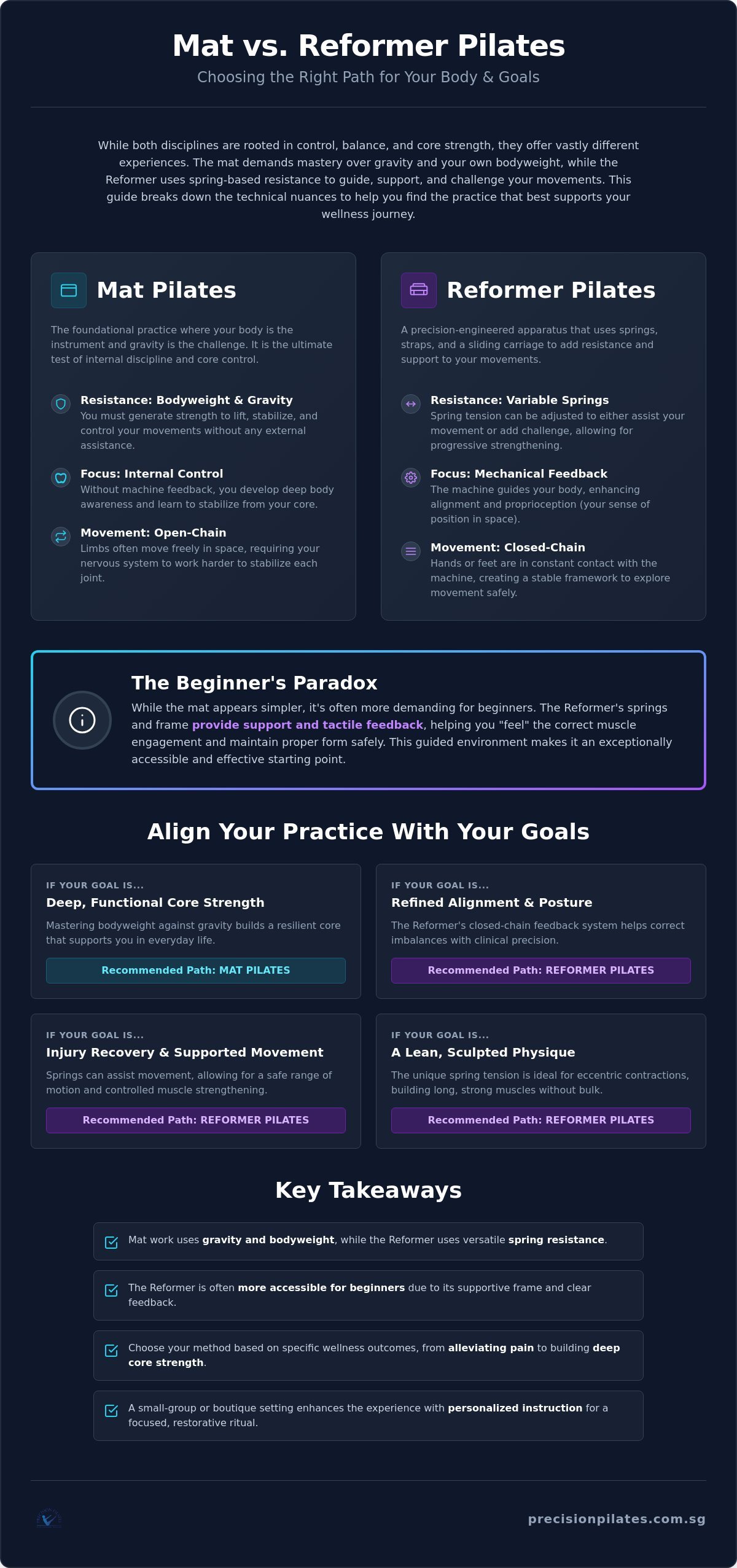
To truly appreciate the nuance of reformer vs mat pilates, one must first embrace the shared philosophy that unites these two paths. Both disciplines are rooted in a commitment to intentionality, balance, and structural integrity. While the mat serves as the foundational practice where you navigate the constant pull of gravity, the Reformer introduces a sophisticated mechanical element to refine and challenge your movement.
These modalities are anchored in the history and principles of Pilates, a methodology developed by Joseph Pilates to foster a deep connection between the mind and the physical self. He originally designed his equipment to serve as a guide, helping students “feel” the correct engagement before they attempted the same exercises on the floor. This concept of mindful movement remains the common thread; it ensures that whether you are on a machine or a mat, your practice is a focused, restorative ritual.
Reformer vs Mat Pilates can also differ in how exercises are progressed, with the Reformer offering adjustable resistance while Mat Pilates relies more heavily on body weight and control.
The Mat: Mastering Gravity and Bodyweight
Mat Pilates is a practice defined by simplicity, focus, and internal discipline. It requires no elaborate setup, making it an accessible entry point for many. However, do not mistake simplicity for ease. On the mat, your body is the only weight, and gravity is your primary resistance. The floor provides immediate, tactile feedback, revealing subtle shifts in your spinal alignment or pelvic stability. It is the ultimate test of core control. You must find the strength to lift, rotate, and stabilize without any external assistance. This practice builds a resilient, functional body that moves with grace and ease in everyday life.
Reformer vs Mat Pilates may also affect how movement range is explored, with the Reformer offering guided support through certain exercises while Mat Pilates develops control through unrestricted floor-based movement.
The Reformer: Engineering Precision with Springs and Straps
The Reformer is a masterfully designed apparatus that brings a sense of clinical precision to your workout. It features a sliding carriage, a system of springs, a footbar, and straps. This environment creates a unique “closed-chain” experience, where your hands or feet are in constant contact with the machine. This contact significantly enhances proprioception, which is your body’s ability to sense its location and movement in space. The Reformer is remarkably versatile. For those new to the practice, the springs offer gentle support and guidance. For advanced practitioners, they provide varying levels of resistance to challenge strength and endurance. It is a tool designed to refine, align, and strengthen the body with unparalleled accuracy.
Reformer vs Mat Pilates also creates different strength demands, as Reformer exercises use spring resistance while Mat Pilates challenges stability and control using your own body weight.
A Reformer vs Mat Pilates comparison is also useful when considering accessibility, since the Reformer can provide additional support while Mat Pilates requires more independent control on the floor.
Resistance vs. Control: The Technical Differences in Movement
Whether you prioritize tactile feedback or internal discipline, the technical distinction between reformer vs mat pilates defines how you build resilience. The Reformer creates a “closed-chain” environment where your extremities remain in constant contact with a fixed surface, such as the footbar or carriage. This setup provides a safe, structured framework for the body to explore movement. In contrast, mat work is primarily “open-chain,” meaning your limbs often move freely through space. Without a machine to guide your path, your nervous system must work harder to stabilize each joint. This distinction is supported by scientific evidence on Pilates’ benefits, which highlights how both methods contribute to long-term postural integrity and functional strength.
Variable Resistance: How the Reformer Refines Strength
The Reformer utilizes a system of springs to create linear resistance. Unlike a static weight, a spring’s tension increases as it’s stretched, requiring your muscles to work harder at the peak of the movement. This unique tension is particularly effective for eccentric contraction, the process of strengthening a muscle while it is lengthening. It’s why many find the Reformer creates a lean, sculpted physique without adding bulk. By adjusting spring tension, an instructor can isolate specific muscle groups to address imbalances or help increase bone density through controlled loading. If you’re ready to experience this mechanical precision firsthand, our Reformer Pilates Classes offer a tailored approach to your individual needs.
The straps and pulleys further elevate the practice. They allow for a range of motion that often exceeds what’s possible on the floor, providing a sense of spaciousness in the joints. This mechanical assistance makes the Reformer an excellent tool for those recovering from injury or anyone seeking a guided, supported experience. It allows you to refine your movement patterns with grace, strength, and accuracy.
Pure Control: Why Mat Pilates is the Ultimate Stability Test
While the Reformer offers support, the mat demands total autonomy. Many practitioners find mat work more challenging because there’s no carriage to assist with momentum and no springs to guide the line of movement. It’s an honest practice. You must rely entirely on your “Powerhouse,” the deep collective of abdominal, back, and pelvic floor muscles, to lift and stabilize your limbs against the constant pull of gravity. The mat doesn’t offer help; it offers a mirror to your internal strength.
This modality requires a higher level of mental concentration to maintain impeccable form. You aren’t just moving; you’re orchestrating every millimeter of the exercise from within. The mat is also a “zero-excuse” practice. Its portability ensures you can maintain your routine anywhere, fostering a consistent and sustainable habit that prioritizes longevity over intensity. Focus. Breathe. Align. This is the heart of the mat.
Performance Outcomes: Which Method Best Serves Your Specific Goals?
Whether you’re an elite athlete seeking to refine explosive power or a professional looking to undo the physical toll of a desk-bound career, the choice between reformer vs mat pilates depends entirely on your desired destination. Both paths offer a journey toward functional fitness, yet they provide different tools for the transformation.
A medically reviewed comparison of Pilates methods suggests that while both improve core stability, the Reformer’s mechanical feedback often accelerates results for those with specific alignment needs. Athletes often utilize the Reformer to isolate and strengthen stabilizers that are difficult to target through traditional weight training. Conversely, wellness seekers often find the mat’s grounding nature provides a profound sense of self-reliance and mental clarity.
When comparing Reformer vs Mat Pilates, the better choice depends on your goals, movement needs and preferred style of training.
For many, the primary catalyst for starting this journey is the search for reformer pilates for back pain relief. The machine’s ability to decompress the spine while strengthening the surrounding musculature is unparalleled. It offers a sanctuary where you can move without fear, knowing the equipment supports your weight. Mat work complements this by teaching you how to maintain that same spinal integrity when you’re out in the world, standing in line, or sitting at a computer. This synergy between the studio sanctuary and daily life is what creates a sustainable, pain-free lifestyle. It’s about more than just a workout; it’s about building a body that feels like home.
Correcting Postural Imbalance and Spinal Alignment
The Reformer acts as a sophisticated diagnostic tool for your posture. Its alignment markers and adjustable resistance help correct “tech neck” and rounded shoulders by providing a clear map of where your body is in space. On the mat, you focus on the posterior chain, the muscles along your back and glutes, to build the strength needed for an upright, confident stance. Postural precision is the foundation of all movement. By addressing these imbalances early, you ensure that every step you take is balanced, harmonious, and efficient.
Rehabilitation and Injury Prevention
The Reformer is often the preferred choice for knee or hip rehabilitation. Its horizontal nature allows you to perform weight-bearing exercises with a fraction of the impact, protecting vulnerable joints while you rebuild strength. Mat Pilates serves as the “protective core” that prevents future injuries. It teaches you to engage your deep stabilizers before you move your limbs, creating a shield of strength around your spine. Expert-led instruction is essential here. A professional guide ensures that your recovery is safe, intentional, and deeply effective. Breathe. Align. Transform.
The Decision Framework: How to Choose the Right Path for Your Body
A common misconception suggests that beginners must master the mat before stepping onto a Reformer. In reality, the machine’s carriage and springs often provide the necessary support that a novice lacks in their own core strength. Choosing between reformer vs mat pilates shouldn’t be an “either-or” struggle but a strategic alignment with your current physical needs.
Whether you’re seeking a guided introduction to movement or an advanced test of internal discipline, the right path is the one that meets you where you are today. Many practitioners find that a synergy of both methods yields the most profound results; use the Reformer for mechanical refinement and the mat for pure, unassisted control.
Investing in a boutique studio experience often raises questions about cost versus value. While mat classes are accessible, the specialized expertise of a “Wellness Architect” ensures your form is precise, safe, and effective. This professional oversight prevents the common injuries associated with improper home practice. You’re not just paying for a class; you’re investing in a personalized roadmap toward structural integrity and long-term health. Align, strengthen, evolve. This is the hallmark of a high-end practice.
For many people comparing Reformer vs Mat Pilates, the best option comes down to goals, experience level and whether they prefer equipment-based or mat-based training.
Assessing Your Current Fitness Level and Experience
If you’re navigating limited mobility or recovering from chronic tension, the Reformer is your strongest ally. Its adjustable resistance allows you to build strength without straining vulnerable joints. Conversely, if you’re an experienced mover seeking to deepen your core conditioning, the mat offers an unparalleled challenge of stability and focus. For those who want to accelerate their progress, private pilates Singapore provides a tailored environment where every movement is scrutinized and refined by an expert eye. This one-on-one attention ensures that your foundation is flawless before you transition into group settings.
Frequency and Consistency: Integrating Pilates into Your Lifestyle
To see transformative results by 2026, consistency is paramount. We recommend a rhythm of two to three sessions per week. This frequency allows your nervous system to integrate new movement patterns while giving your muscles time to recover and adapt. You might choose to attend two studio Reformer sessions for technical guidance and supplement them with a home-based mat practice for daily maintenance. This balance keeps your routine sustainable and engaging. Remember, the support of a mindful community often makes the difference between a fleeting habit and a lifelong commitment to wellness. If you’re ready to begin your transformation, we invite you to discover the difference of a tailored approach at Precision Pilates Studio.
Elevating Your Practice: The Boutique Experience at Precision Pilates Studio
Choosing between reformer vs mat pilates is a technical decision, but where you practice is a lifestyle choice. At Precision Pilates Studio, we view movement through the lens of a Wellness Architect. We don’t just lead exercises; we design sessions that restore balance, enhance harmony, and build structural integrity. Unlike the chaotic environment of a generic gym, our studio serves as a serene sanctuary. Here, the focus remains entirely on your personal transformation. By integrating reformer pilates Singapore with a broader holistic approach, we ensure that your physical exertion is always balanced by mental tranquility. We invite you to step away from the noise and enter a space dedicated to your long-term well-being.
Reformer vs Mat Pilates may also influence how easily you can maintain a regular routine, since Mat Pilates can be practised almost anywhere while Reformer sessions require specialised equipment.
The boutique experience is defined by intentionality. Every detail, from the ambient lighting to the sequence of movements, is curated to foster a state of motivated readiness. Whether you’re seeking to alleviate chronic tension or refine your athletic performance, our studio provides the expert-led environment you need to thrive. We believe that true progress requires a steady, composed presence. It’s about more than just a workout. It’s a commitment to a more focused, intentional version of yourself.
The Allegro 2 Advantage: Why Equipment Quality Matters
The quality of your equipment directly impacts the quality of your movement. We utilize the Allegro 2 Reformer, widely regarded for its technical superiority and clinical precision. Its EasySet Footbar and smooth-glide carriage allow for transitions that feel seamless and fluid. This high-end engineering reduces unnecessary joint strain, ensuring that your resistance training is both safe and effective. The tactile experience of premium equipment encourages a deeper connection to your practice. It’s a difference you can feel in every repetition. Smooth, precise, and supportive; these are the hallmarks of our equipment standards.
Personalised Guidance: Small Groups and Private Instruction
The most significant advantage of a boutique setting is the “expert eye.” In our small-group classes, you’re never just a face in a crowd. Our instructors possess the technical knowledge to spot subtle misalignments that larger classes often miss. They tailor each movement to your specific postural needs, ensuring that you’re working with your body rather than against it. This level of personalised attention accelerates your results and builds a foundation of confidence.
We encourage you to book a trial class to feel the difference that professional mentorship can make. Listen, move, transform. Your journey toward a more resilient self begins with a single, mindful step.
Charting Your Path to Precision
Choosing your ideal practice is a personal evolution that aligns your physical needs with your long-term wellness goals. Whether you’re drawn to the technical refinement of the Reformer or the internal discipline of the mat, the journey of reformer vs mat pilates is about building a body that moves with grace and integrity. You’ve discovered how the Reformer provides mechanical feedback for alignment, while the mat serves as the ultimate test of internal core strength. Both paths offer a transformative route to improved posture, pain-free movement, and a sustainable fitness routine for the years ahead.
At Precision Pilates Studio, we provide the expert-led environment necessary to unlock your potential. Our serene boutique sanctuary features premium Allegro 2 Reformers and small-group sessions that ensure you receive the personalized attention you deserve. Every breath, every movement, and every alignment is guided by a Wellness Architect dedicated to your growth. Begin your journey to mindful strength; book your trial class at Precision Pilates Studio today. We look forward to supporting your transformation in a space focused on your tranquility and strength.
Frequently Asked Questions
Is Reformer Pilates better than Mat Pilates for weight loss?
Reformer Pilates often provides a more direct path to weight loss because the spring resistance allows for higher intensity and increased muscle loading. While both methods build lean muscle and boost metabolism, the Reformer’s dynamic environment encourages greater cardiovascular engagement during your session. Whether you choose reformer vs mat pilates, sustainable weight management is most effective when your movement is consistent, intentional, and balanced with a mindful lifestyle.
Can I do Reformer Pilates if I have a back injury?
You can safely practice Reformer Pilates with a back injury if you have clearance from your medical provider. The machine’s horizontal carriage and adjustable springs allow you to strengthen your core without the compressive forces of gravity on your spine. This supportive environment helps you decompress, stabilize, and restore your back’s health. For a structured approach to your recovery, our reformer pilates for back pain relief checklist outlines the essential steps to rebuild strength safely and effectively. It’s a precise and gentle way to rebuild your physical confidence after an injury.
How often should I do Pilates to see a change in my posture?
Most practitioners begin to notice a visible change in their posture within four to six weeks of consistent practice. We recommend attending sessions two to three times per week to allow your nervous system to integrate new alignment patterns effectively. This frequency ensures your body has the necessary time to adapt, strengthen, and refine its structural integrity. Consistency is the architect of long-term physical transformation.
Do I need to be flexible to start Mat Pilates classes?
You don’t need to be flexible to start Mat Pilates; rather, improving your range of motion is one of the primary goals of the practice. Mat work uses your own bodyweight to gently lengthen tight muscles while building the strength needed to support them. Our instructors provide modifications for every level to ensure you feel supported and successful. Flexibility is a journey of refinement, not a prerequisite for entry.
What should I wear to my first Reformer Pilates session?
Choose form-fitting athletic clothing that allows your instructor to clearly observe your alignment and joint movement. Avoid loose garments that might get caught in the Reformer’s springs or sliding carriage. Grip socks are essential for maintaining stability and safety on the machine’s various surfaces. Select fabrics that are breathable, flexible, and comfortable to ensure your focus remains entirely on your practice.
Is it better to start with a private session or a group class?
Starting with a private session is highly recommended to establish a flawless foundation and understand the mechanics of the equipment. This one-on-one attention allows your instructor to tailor the practice to your specific postural needs and goals. It ensures that when you transition into a group class, you move with precision, safety, and confidence. Personalised guidance is the most efficient path to mastering the reformer vs mat pilates techniques. For a deeper understanding of what to expect in your first sessions, our reformer pilates beginners Singapore FAQ guide addresses the most common questions new practitioners encounter before stepping onto the machine.
Reformer vs Mat Pilates can also feel quite different during a class, as the Reformer provides equipment-based feedback while Mat Pilates places greater emphasis on body awareness and self-controlled movement.
Can I combine Pilates with Yoga for better results?
Combining Pilates with Yoga creates a powerful synergy that addresses both structural strength and mental tranquility. While Pilates focuses on deep core stability and alignment, Yoga offers a profound exploration of flexibility and breathwork. This dual approach fosters a body that is resilient, balanced, and harmonious. It’s an excellent way to diversify your wellness ritual and achieve a more holistic sense of well-being.
Why is Reformer Pilates more expensive than Mat Pilates?
Reformer Pilates involves a higher investment due to the precision engineering and regular maintenance required for the specialized equipment. Additionally, Reformer sessions are typically conducted in smaller groups to ensure that every individual receives expert-led attention and form correction. This boutique approach guarantees a safer and more tailored experience. You’re investing in high-end equipment, specialized expertise, and a focused environment designed for your success.

Article by
Precision Pilates Studio Singapore
Precision Pilates Studio Singapore is a boutique Pilates and wellness studio in Marine Parade offering Reformer Pilates, Mat Pilates, Yoga, Yogalates, Sound Healing, Breathwork and personalised movement sessions. Our content is created to provide practical, educational information that supports safer movement, better posture, strength, mobility and overall wellbeing.
Disclaimer
The information in this article is provided for general educational and informational purposes only. It is not intended to replace professional medical advice, diagnosis or treatment. Individual needs and health conditions vary. Please consult a qualified healthcare professional before beginning a new exercise or wellness programme, especially if you are pregnant, recovering from an injury, experiencing pain or managing a medical condition. Precision Pilates Studio does not provide medical diagnosis or treatment.